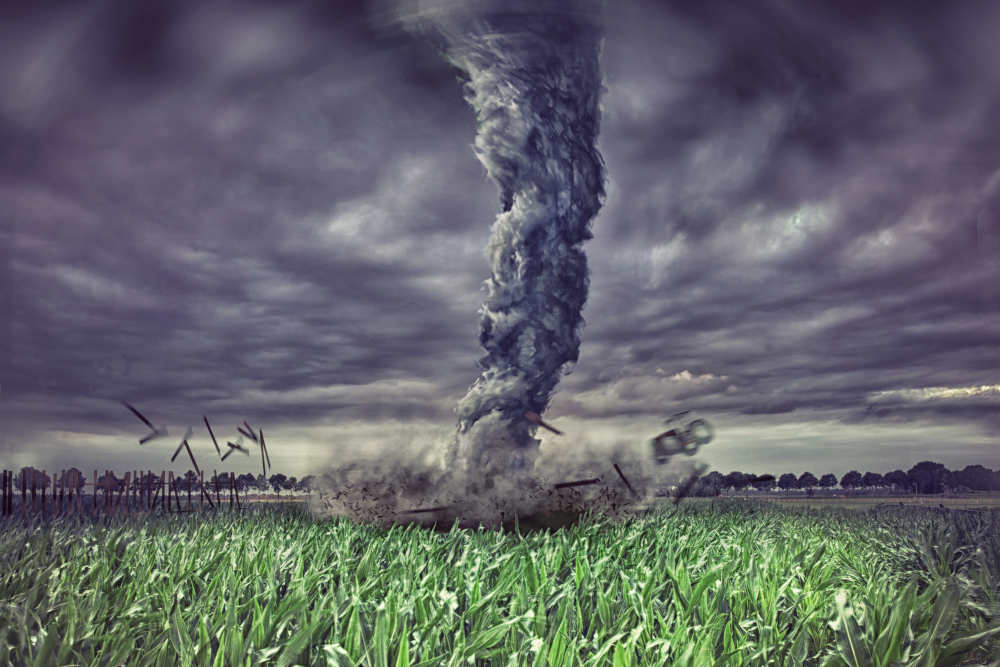
Russia and China are at the forefront of a group of nations investing in geoengineering capabilities, according to the Royal United Services Institute, a UK think tank that has studied the growing threat of “weather warfare.”
Under the premise of climate research, research into the technologies and systems needed to manipulate weather patterns for strategic or military purposes is taking place, the institute reports.
The institute, Britain’s oldest defense think tank, issued a sobering alert on weather weaponization this year, warning that “Moscow could seek to induce climate extremes, such as drought or flooding, by deploying solar geo-engineering technologies against an adversary, disrupting agricultural production and the operation of critical infrastructure.”
Technologies such as cloud seeding date back to the 1940s. But efforts remain imprecise and could still backfire. The United States, Russia, and China agreed to abandon the use of weather as a weapon of war under the Environmental Modification Convention of 1978. Other world leaders in cloud seeding, such as France, Israel, and other Middle Eastern countries, have not acceded to the agreement. These countries and many others continue to develop geoengineering for peaceful purposes, though the line between the two is increasingly blurred. The potential is certainly there for its use in warfare.
Immediately before Jesus’ second coming, the Bible speaks of “men’s hearts failing them from fear and the expectation of those things which are coming on the earth, for the powers of the heavens will be shaken.” Luke 21:26–27, NKJV. We don’t know if weaponized weather will contribute to this situation, but it’s possible. Current speculation about its use reminds us that we’re getting closer to history’s final drama.
“Weaponized weather emerges as new hybrid warfare tool,” The Washington Times, Nov. 28, 2025.
A recent collaboration of Bible agencies has identified a growing international crisis in Bible access.
About 100 million Christians in 88 countries—around a fifth of the global church—can’t freely read their own copy of the Bible in their own language without challenges, according to the first report of the Bible Access Initiative. Of the top 20 countries ranked by Bible shortage, 14 are in Africa.
A separate ranking designates countries that restrict Bible ownership and distribution. In at least 15 countries, importing, printing, and distributing the Bible is illegal, and Bible ownership comes with restrictions. The five countries with the most Bible restrictions are Somalia, Afghanistan, Yemen, North Korea, and Mauritania. An additional 18 countries place “severe” restrictions on Bible access.
In each of the four countries facing the most Bible shortages—the Democratic Republic of Congo, Nigeria, Ethiopia, and India—more than 10 million believers lack access to the Bible.
The shortages are growing. Under current regulations in India, for example, restrictions on foreign funding have crippled several long-standing Christian organizations that once supplied Bibles to poorer communities.
In an effort to overcome such problems, the Digital Bible Society is shipping microSD cards to northern India. The cards are loaded with thousands of resources, including audio Bibles, videos, and children’s programming. The cards slip into the back of most Android devices. In other regions, a God Pod—an audio Bible on a solar-powered device—makes the most sense.
Throughout history, governments have sought to suppress Scripture, but they can never extinguish its message. The Bible itself predicts famine of the Word of God. Amos 8:11–12. We still have opportunities to help offset the current one.
“Where Millions of Christians Don’t Get to Read the Bible,” Christianity Today, Oct. 21, 2025.
No one would want to work without getting a salary, or even worse―having to pay to be there. Yet paying companies so you can pretend to work for them has become popular among young, unemployed adults in China. It has led to a growing number of such providers.
The development comes amid China’s sluggish economy and job market. Chinese youth unemployment remains stubbornly high, at more than 14 percent. With real jobs increasingly hard to come by, some young adults would rather pay to go into an office than be just stuck at home.
Shui Zhou, 30, had a food business venture that failed in 2024. In April 2025, he started to pay 30 yuan ($4.20) per day to go into a mock-up office run by a business called Pretend To Work Company.
There he joins five “colleagues” who are doing the same thing. “I feel very happy,” says Mr. Zhou. “It’s like we’re working together as a group.”
Such operations are now appearing in major cities across China. Often, they look like fully functional offices equipped with computers, internet access, meeting rooms, and tea rooms.
And rather than attendees just sitting around, they can use the computers to search for jobs or to try to launch their own start-up businesses. Sometimes the daily fee, usually between 30 and 50 yuan, includes lunch, snacks, and drinks.
The 30-year-old owner of the Pretend To Work Company comments, “What I’m selling isn’t a workstation, but the dignity of not being a useless person.”
Pretending to work is just another sad step in the quest for dignity and meaning facing young adults today. Jesus offers true usefulness before His second coming―for free!
“China’s unemployed young adults who are pretending to have jobs,” BBC News Chinese, Aug. 10, 2025.
What if the voice preaching to you on YouTube wasn’t your favorite pastor at all―but a digital imposter, crafted by algorithms, spouting counterfeit sermons with the voice and mannerisms of someone you trust?
A new channel from a popular evangelical preacher appeared innocently enough in March 2025, with its banner promising “life-changing teaching” and “biblical wisdom” from a man revered for his steadfast expositional preaching. Within weeks, it posted nearly 100 videos, some garnering close to 100,000 views. Viewers heard familiar cadences, biblical phrases, and warnings about sin, false converts, and end-time deception—all staples of this preacher’s ministry.
But buried between recognizable sermon clips were red flags: bizarre video titles, strange voice glitches, and fabricated content no discerning listener could attribute to the real preacher. AI mispronunciations (“Two Corinthians” instead of “Second Corinthians”), fake doctrinal claims, and YouTube disclaimers buried in the video description confirmed what many suspected: these sermons are AI generated.
“What shall be the sign of Thy coming,
and of the end of the world?” Matthew 24:3
But deepfakes are constantly improving. Soon these AI clues will disappear. How will we identify a fake then?
Instead of testing what they hear and studying the Bible themselves, many people today follow personalities, podcasts, and channels that make spiritual life feel easy and accessible. But in an age where deepfakes can manipulate faces and AI can mimic sermons, trust alone is not enough.
When Jesus was warning His disciples about signs of the end, He specifically mentioned enormous deceptions: “For false christs and false prophets will rise and show great signs and wonders to deceive, if possible, even the elect.” Matt. 24:24, NKJV. Deceptions are reaching a new level, and the only detection tool we have is the Bible. We must study it for ourselves and know what it says.
“AI Clone―or Your Favorite Pastor―Can You Tell the Difference?,” Evangelise Ministries (blog), June 6, 2025.
Image credit: © Shutterstock.com