
Have I got a story for you! It’s about how God reached me through the eyes of a little boy named Caleb.
My brother Rick and I were living in a small apartment in Seattle, Washington. We were attending college and trying to finish our education by working nights and studying days.
Rick went to church regularly. He had found Jesus during his time at a Christian high school. As for me, I had rebelled against my parents since their divorce and had been on my own for a few years prior to joining Rick.
“Hey Sam,” he said while we were sitting in the kitchen, “would you like to go to church with me?”
“Look,” I said, “I have told you a million times, if you want to go to church, that’s wonderful, and if you believe in God—terrific. But this religion thing is not for me, so back off.”
“Alright,” he said. “I tell you what—I’ll make a deal with you. You come to church with me once, and I’ll never bother you again about religion.”
The offer was melodic. Rick was relentless in trying to convert me. Every week it was the same question from him with the same answer from me. Now here was an opportunity to never again hear my kid brother drone on about how he’s going to miss me in heaven.
“You’ve got a deal,” I shouted. “I go once, and you never bother me again, agreed?”
“Agreed.”
“One condition,” I added. “If I go, I go as I am,” pointing my finger at him. “I’m not going to be any different from what I normally would be.”
“Agreed,” he said again.
I wanted to throw the Bible away, but it had my name in it—in little-kid chicken scratch.
Sabbath came, and I was ready. I remembered one thing about church people: if you didn’t look like them, they left you alone. I had earrings in each ear, and to complement the presentation I wore my torn Levi jeans, black hiking boots, and a matching biker’s jacket. I left gritty stubble on my face—and a gritty countenance.
“Let’s go,” I said to my brother. Rick wasn’t overly surprised when he saw me. “OK,” he replied, “let’s go.”
When we arrived at the church, there were a few people who shook my hand. I wasn’t stupid—I knew these people had been prepped for my arrival. But overall, what I thought would happen did happen. The church just didn’t know what to make of me, and they left me alone.
As the sermon began, the pastor asked the church to turn in their Bibles to a passage. The rustling of rice paper pages began to fill the room as members were finding the book and the chapter. I sat quietly with my arms crossed against my chest and my back slightly slouched in the pew. There were only 30 minutes left, and I would be free from my brother’s nagging!
While the others were turning in their Bibles, I didn’t have one, nor did I want one. Suddenly I felt a tug on my jacket. I turned and faced a little curly-haired, light-skinned young boy no more than 10 years old. “Hi,” he said to me. “My name is Caleb.”
“Hi,” I snapped back. I then quickly turned toward the pastor again, trying to make clear that I was not interested in getting to know anyone. The tug came again. This time I scowled and said, “What?”
“What’s your name?” he asked, unabashed.
“Kid, if I tell you my name, will you leave me alone?” I said rapidly.
“Maybe.”
I was prepared for adult attempts at conversion but I found myself helpless against this curious little nosy kid!
“My name is Sam,” I said. I looked closely at him and whispered, “Now listen carefully to the sermon. You might learn something.”
Caleb then turned away from me and faced the front. He pulled out one of those plastic ballpoint pens. From my side view I saw little fingers tightly pressed around the pen and a tongue hanging out of his mouth in determined concentration. He was writing something in his Bible, and I knew his attention was away from me. But the writing soon stopped, the tongue was back in his mouth, and he turned toward me again and nudged my shoulder with his Bible.
“It’s for you,” he said as both our hands held the book at the same time. “I wrote your name in it,” a big toothy grin flashed.
I looked at the Bible, then held it back out to him. “I don’t want this, kid. You keep it.”
Caleb began shifting away in the pew. “No, really, it’s for you,” he said.
I didn’t want to make a scene in front of everybody over why I didn’t want this Bible, so the exchange was made, and we both sat quietly.
The service ended, and I made a sprint for the door. I was in the car waiting for my brother.
“Whadya think?” he asked.
“I hated it,” I said. “I told you, if you believe, that’s great, but it’s not for me, and I want no part of it. I’ve kept my end of this deal. Now I never want to hear any conversion stuff from you anymore.” The rest of the ride home was silent.
When we got home, I walked in carrying that Bible. I didn’t know what to do with it. I wanted to throw it away, but it had my name written in it in little-kid chicken scratch. So I placed it on top of the fridge. When I returned in the evening and sat in the kitchen to eat something, the Bible was still there. I felt bothered by it, so I tossed it in the living room. When I went into the living room to watch TV, there it sat again.
Over the next four days, that Bible moved from place to place to place in our apartment, depending on which room I was in. On Thursday night, I was lying on my bed. It was one of those nights when the air stood still and you could see the street lights filter through the raindrops on the window. All was quiet, and I just lay there. I looked over, and that Bible was sitting on my dresser. It cast a shadow on the wall in the dim light of the bedroom. I gazed at it, and the thoughts started unfolding in my mind:
Does He really exist?
Where did I come from, and where am I going?
Is this all there is to life—the garbage I have lived through these past 22 years?
If Jesus Christ doesn’t exist, if He is just a myth, why do I hate Him so much?
What possessed a kid to give me his Bible when I looked the way I did?
The questions kept coming as I lay there. I had been running all my life. From what? I didn’t believe, so why run? I had to get some answers, and now was the time.
I walked across the kitchen to my brother’s bedroom.
“Look,” I said to him sternly. “Don’t flip out on me, don’t get all excited, or even think this really means anything, but I have a few questions I need answered. I guess I would like to ask your pastor about them.”
Rick looked back at me, grinned, and said, “Sure.” A year and a half later, I was baptized.
I stared at the Bible and wondered, Did God really exist? If He was only a myth, why did I hate Him so much? I had been running all my life, but from what?
Even now as I sit to write this story and go over it again, I am awed at the length Jesus would go to save me. I am amazed at how much He really loved me when I hated Him. It has changed my life forever.
A little while after I was baptized, I made a small presentation. I told my story to the entire church as the “Amens” and “Praise Gods” echoed through the sanctuary. I called Caleb up front and talked about the power one person can have when they live by faith and not by sight. I handed him a present. It was a brand-new, black leather-bound Bible with his name in gold letters imprinted on the front. “Thanks, Caleb,” I told him. “Thanks for being the glimpse of God that changed the way I saw Him forever.”
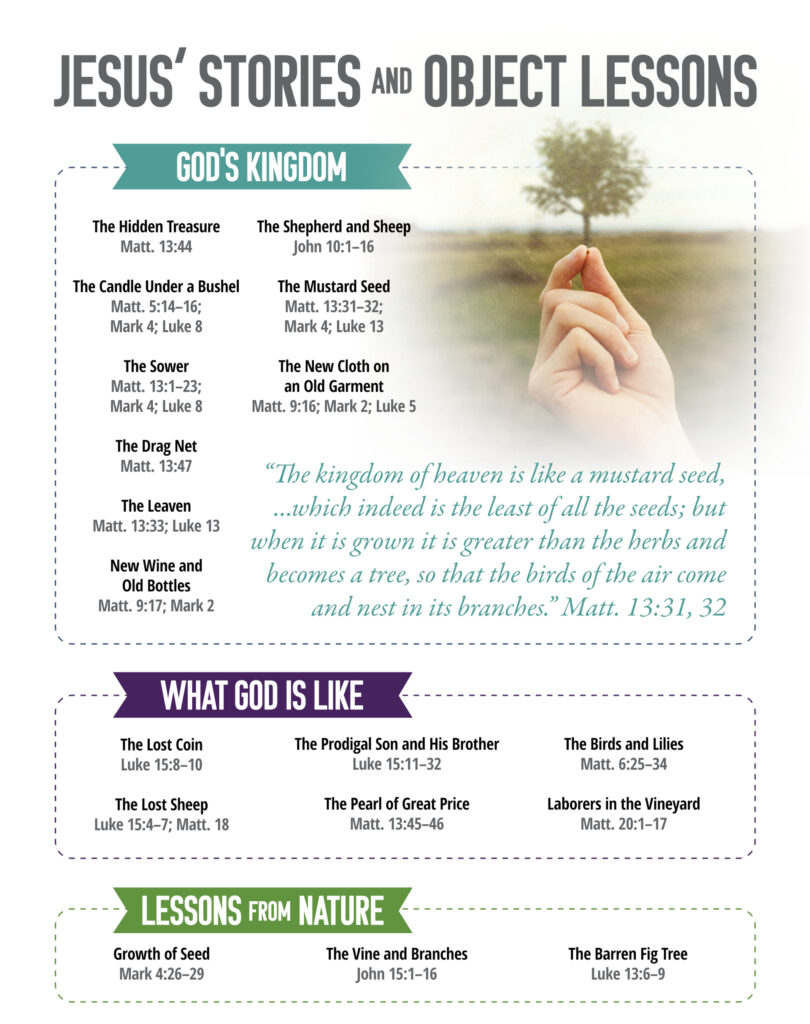
Epilogue: Jesus told three parables about seeking the lost: The Lost Coin, The Lost Sheep, and The Prodigal Son. He loves to have us help Him find them like Caleb did. Sam Willis went on to become a pastor.
*All names in the story are pseudonyms.
The original version of this article was published in College and University Dialogue 10:1 (1998) and is available on https://dialogue.adventist.org/409/for-eternity-i-shall-offer-applause. Used by permission.
Take our "Seach the Word" Quiz
Listen to this article below
Shiana’s life was not what she wanted it to be. She never felt that she was good enough or slender enough or likable enough. She wanted to follow God, but something was missing. One day, while reading a magazine article, she found that missing piece. The article presented a challenge: to spend time praying first thing in the morning. Shiana had never prayed a lot. What would she say to God?
Shiana decided to take the challenge to pray every morning. She reached out to her friend Kayla, asking Kayla to be her accountability partner in the challenge. Each morning, they would call one another when their alarms went off at 6 AM. After briefly praying together, they would hang up their phones and take time in personal prayer to God.
Shiana still remembers that first morning: “I didn’t know if I could pray for more than a minute! Five minutes felt so long!”
But as time went on, it became easier. She began opening her heart to God, finding an outlet for pent-up emotions. She could share with God everything that was going on in her life, including her struggles with self-worth.
The change in her life didn’t happen overnight. But one day, she paused to reflect and realized that she had a renewed sense of peace. God had become a precious friend to her—the One she could turn to. Shiana shares, “That year was a turning point in my life. I will always see it as the year that my relationship with God became real to me.”
“Be anxious for nothing, but in everything by prayer and supplication, with thanksgiving, let your requests be made known to God.” Philippians 4:6
Prayer can seem like a nice practice, but is it essential? Does it really make a difference in the life of a believer? Let’s explore this in the Bible.
1. What are followers of God invited to do?
Hebrews 4:14–16 Seeing then that we have a great High Priest who has passed through the heavens, Jesus the Son of God, let us hold fast our confession. For we do not have a High Priest who cannot sympathize with our weaknesses, but was in all points tempted as we are, yet without sin. Let us therefore come boldly to the throne of grace, that we may obtain mercy and find grace to help in time of need.
Jesus is our High Priest in heaven who can understand us and relate to us. Though we can’t literally go to His throne
right now, we can do so through prayer. There, we will find the mercy and help we need for every situation.
The Bible has countless verses about prayer and stories of people who prayed. Just look at the Psalms—they are full of David’s prayers to God! He turned to God in every situation, whether he was joyful, thankful, sad, or angry. We should likewise see prayer as a way to develop a deeper relationship with God. We can talk to Him about our daily lives just the way we would share with a friend.
2. What is one of the purposes of personal prayer?
1 Peter 5:7 Casting all your care upon Him, for He cares for you.
Philippians 4:6–7 Be anxious for nothing, but in everything by prayer and supplication, with thanksgiving, let your requests be made known to God; and the peace of God, which surpasses all understanding, will guard your hearts and minds through Christ Jesus.
Personal prayer time gives us the opportunity to cast all our cares upon God. We can tell Him what we may not want anyone else on this earth to hear. Prayer also allows us to open our hearts to Him, asking Him to search us and reveal areas of our lives that need to change. See Psalm 139:23–24. He also speaks back to us through the Bible; that’s why we should combine our personal prayer time with Bible study.
3. Why do we sometimes miss out on God’s blessings?
John 16:24 Until now you have asked nothing in My name. Ask, and you will receive, that your joy may be full.
Matthew 7:7–8 Ask, and it will be given to you; seek, and you will find; knock, and it will be opened to you. For everyone who asks receives, and he who seeks finds, and to him who knocks it will be opened.
God has so many blessings He wants to give us: the Holy Spirit, victory over temptation, peace, joy, courage, and more. But we won’t be able to receive these blessings if we don’t ask for them! Often, it’s in the asking that God prepares us to receive the gifts He wants to give us.
1. What else should we pray for?
James 5:16 Confess your trespasses to one another, and pray for one another, that you may be healed. The effective, fervent prayer of a righteous man avails much.
We are to pray for others—this is sometimes called intercession. Though we can most definitely pray for our needs, intercession for others shifts our focus from ourselves to how we can benefit those we are praying for. We may even find that praying for someone difficult in our lives changes our attitude toward them!
2. When should we pray?
Psalm 55:17 Evening and morning and at noon I will pray, and cry aloud, and He shall hear my voice.
Though the Bible doesn’t prescribe prayer at certain times, it does encourage having a habit of prayer each day. Beginning the day with God helps us to put our priorities in the right place and seek His strength for the day ahead.
3. How should we approach God?
Matthew 6:7–8 And when you pray, do not use vain repetitions as the heathen do. For they think that they will be heard for their many words. Therefore do not be like them.
God wants to hear from our hearts; He doesn’t want us to just repeat ritualistic prayers. We should approach Him with a sense of reverence for who He is, but at the same time, we can confide in Him the way a child confides in a loving parent.
Remember, our goal in prayer is not simply to get answers. It is also to know the heart of the One who answers prayer.
4. What are the conditions for answered prayer? See if you can spot the principles in the following verses.
An undivided heart that isn’t cherishing sin
Jeremiah 29:13 You will seek Me and find Me, when you search for Me with all your heart.
Praying according to God’s will
1 John 5:14 Now this is the confidence that we have in Him, that if we ask anything according to His will, He hears us.
Asking unselfishly
James 4:3 You ask and do not receive, because you ask amiss, that you may spend it on your pleasures.
Faith
Mark 11:24 Therefore I say to you, whatever things you ask when you pray, believe that you receive them, and you will have them.
Persistence (fervency)
James 5:16 The effective, fervent prayer of a righteous man avails much.
If you find that your prayer isn’t being answered, take time to evaluate it according to these principles. Remember, our goal in prayer is not simply to get answers. It is also to know the heart of the Prayer Answerer.
SUMMARY
Following the Bible’s prayer guidelines is essential for enlivening our experience with God and deepening our relationship with Him.
COMMITMENT
I choose to give quality time to prayer daily and seek a closer walk with God through it.
All verses quoted are taken from the New King James Version of the Bible.
Papaya is sometimes called pawpaw, but that’s not the fruit we’re talking about here. Pawpaw fruits, like soursop, guanabana, sweetsop, sugar apple, cherimoya, and custard apple, contain neurotoxins that may cause a neurodegenerative disease. They’re found and eaten in many regions of the world, including parts of the US.
Pawpaws have a custard-like texture and taste like a mixture of bananas, mangos, and pineapples. They’re found in temperate forests in the Eastern US, and they even have their own pawpaw festivals.
Unfortunately, they contain three types of neurotoxins that can make you very sick. They are all linked to a neurodegenerative disease which is like a treatment-resistant Parkinson’s with hallucinations, widespread brain atrophy, and dementia.
Spread the word if you know anyone who eats this deceptive fruit. Not everything that tastes good is good.
“Do Not Eat Pawpaws,” Nutritionfacts.org, July 28, 2025.
Keeping your heart healthy can start as soon as you get out of bed and step into the shower if you belt out a few musical numbers while you’re washing!
That’s according to several studies, including research by the Medical College of Wisconsin that found singing for 14 minutes a day could have a similar positive impact on your heart rate variability (HRV) as light exercise. HRV—the variation in the time between heartbeats—is one of the key hallmarks of cardio health.
“Physiologically, singing involves controlled diaphragmatic breathing and sustained exhalation, which improve respiratory function. Singing mimics exercise by increasing oxygen consumption and heart rate while fostering synchronization between heart rhythms and respiration,” says Ragavendra Baliga, a cardiologist and professor of internal medicine at Ohio State University.
A positive outlook on life may protect against memory loss in middle age, according to a recent 16-year-long study by researchers in the UK, US, and Spain. The study suggests that well-being is significantly associated with better memory recall.
In the research, 12,099 people over the age of 50 were studied over a 16-year period in nine biannual sessions. They completed tests of immediate and delayed memory using word lists and filled out well-being questionnaires. In the study, well-being was defined as a combination of emotional health (e.g., happiness, confidence) and effective functioning (e.g., control over life, sense of purpose).
The researchers found that higher well-being was consistently associated with higher immediate and delayed memory scores. The results were consistent with previous research, which has shown that well-being is significantly associated with better mental processes.
Fast walking for just 15 minutes a day could significantly reduce the risk of early death—especially for low-income and Black/African-American populations—according to a major new study published in the July 2025 American Journal of Preventive Medicine.
Drawing on data from nearly 80,000 participants, researchers found that brisk walking was linked to a nearly 20% reduction in all-cause mortality.
“While the health benefits of daily walking are well-established, limited research has investigated the effects of factors such as walking pace on mortality, particularly in low-income and Black/African-American populations,” said lead investigator Dr. Wei Zheng of Vanderbilt University Medical Center.
By contrast, slow walking for over three hours a day was only linked to a modest 4% reduction, suggesting intensity matters more than duration.
The number of lung cancer cases in people who have never smoked is increasing. The disease is different from lung cancer caused by smoking, so what causes it?
Air pollution is the second leading cause of all lung cancer cases after smoking. Studies have revealed that people who live in highly polluted areas are more likely to die of lung cancer than those who do not. Particulate matter (PM) less than 2.5 microns in diameter (about a thirtieth of the width of a human hair), typically found in vehicle exhaust and fossil fuel smoke, seems to play an important role. And research has shown a strong link between high levels of PM2.5 and lung cancer in individuals who have never smoked.
“With the increasing risk of wildfires, air pollution and PM2.5 levels are rising again in certain regions of the US,” says Christine Berg, a retired oncologist from the National Cancer Institute in Maryland. “At least one study has shown an association between wildfire exposure and increased incidence of lung cancer.”
In 2021, the World Health Organization (WHO) halved the annual mean air quality guideline for PM2.5, meaning it has adopted a more stringent approach to particulate matter. “But 99% of the world population lives in areas where air pollution levels exceed [these updated] WHO guideline limits,” says Ganfeng Luo of the International Agency for Research on Cancer in France. In Delhi, for example, the average PM2.5 levels are 20 times above the WHO air quality guidelines.
Exposure to radon gas is another leading cause of lung cancer worldwide. In 2015 it was estimated that 3–20% of global lung cancer deaths could be attributed to radon exposure, and this percentage reached 30% in never-smokers.
We’re certainly seeing the “earth [growing] old like a garment, and those who dwell in it [dying] in like manner” (Isa. 51:6)—another sign that it’s time for Christ to return.
“The mystery rise of lung cancer in non-smokers,” BBC, June 6, 2025.
“Radon and lung cancer: Current status and future prospects,” Science Direct, June 2024.
Over a third of US students believe it is acceptable to use violence to stop a speech on a college campus, according to a new survey.
The Foundation of Individual Rights and Expression (FIRE) has published its 2026 College Free Speech Rankings, an annual review of American universities’ speech protections and climate of open inquiry.
When asked whether using violence to stop a public speaker on campus is acceptable, only 66% of students responded that the tactic is “never acceptable.” 15% responded that violence is always or sometimes acceptable, with a further 19% saying that it was “rarely acceptable.” The combined 34% is a record figure. In 2022, that figure was 20%.
“Fewer students believe that controversial ideas should be heard on campus, and more are willing to allow others to suppress speech through disruption—or even violence—than ever before,” FIRE’s chief research advisor, Sean Stevens, says of this year’s data. “These aren’t isolated findings; they represent a troubling, accelerating shift on campuses across the country.”
Speculating on the reason for this, he says, “Intolerance can rise with increases in political polarization, something that has been happening among the general public for a while. I do think the features offered by social media, the ability to curate a feed with things one likes while filtering out things they don’t like, play into the rise in intolerance among today’s undergraduates.”
The book of Revelation prophesies a situation of extreme intolerance and removal of freedoms in the last days, even in the United States. This report is evidence of widespread movement in that direction already.
“Third of US students say violence is acceptable response to speech,” Unherd.com, Sept. 9, 2025.
“Map Shows Colleges Ranked Best—and Worst—for Free Speech,” Newsweek, Sept. 13, 2025.
In July 2025, Dr. Robert Endres of the Department of Life Sciences, Imperial College, London, published a paper revisiting the question of how life on Earth began. Endres’s contributions are new formulas for examining the likelihood of a spontaneous beginning of life on Earth.
Summarizing his work scientifically, he says, “Using estimates grounded in modern computational models, we evaluate the difficulty of assembling structured biological information under plausible prebiotic conditions. Our results highlight the formidable entropic and informational barriers to forming a viable protocell within the available window of Earth’s early history.” That is to say that despite help from AI, it’s clear that life on Earth is extremely unlikely to have come into being by itself.
Faced with the same dilemma back in 1973, Francis Crick (codiscoverer of DNA’s structure) and Leslie Orgel proposed the idea of “directed panspermia.” Endres explains, “In their scenario, an advanced extraterrestrial civilization, facing extinction or perhaps scientific curiosity, dispatched microbial ‘starter kits’ to habitable planets like ours.” He then comments, “While Crick and Orgel attempted to formulate this idea more like a testable hypothesis, it deftly relocates the explanatory burden to someone else’s biochemistry.” Endres recognizes that at best, it only accounts for how life got to Earth, not how it began. But he has no other suggestions.
Although Endres’s paper caused a momentary flurry in the popular media (people love articles about space aliens), there’s nothing new here. Scientists are still sidestepping the possibility that there’s a Creator, even if they have to turn to science fiction to do it! Meanwhile, the mounting scientific evidences of design in biology and fine-tuning in chemistry and physics unerringly point us back to the Bible.
“The unreasonable likelihood of being,” ResearchGate, July 25, 2025.
Does ChatGPT harm critical thinking abilities? A new study from researchers at MIT’s Media Lab has returned some concerning results.
The study divided 54 subjects—18- to 39-year-olds from the Boston area—into three groups, and asked them to write several SAT essays using OpenAI’s ChatGPT, Google’s search engine, and nothing at all, respectively. Researchers used an EEG to record the writers’ brain activity across 32 regions.
They found that of the three groups, ChatGPT users had the lowest brain engagement and “consistently underperformed at neural, linguistic, and behavioral levels.” Over the course of several months, ChatGPT users got lazier with each subsequent essay, often resorting to copy-and-paste by the end of the study.
Psychiatrist Dr. Zishan Kha says that he sees many kids who rely heavily on AI for their schoolwork. “From a psychiatric standpoint, I see that overreliance on these LLMs can have unintended psychological and cognitive consequences, especially for young people whose brains are still developing,” he says. “These neural connections that help you in accessing information, the memory of facts, and the ability to be resilient: all that is going to weaken.”
The deceptions and pressures of the last days require stronger rather than weaker thinking skills. We need to do all we can to encourage and help young people to develop them. Let’s guard ours, too.
I used to think I would never send my daughter anywhere as a teenager unless I went with her. Even when she became a young adult, I imagined being by her side. I wanted to stay close—to protect her, guide her, and always be there.
One Sabbath morning, during the quiet break between our group Bible study and our church service, I walked around the parking lot, praying. The sun was shining, the sky was clear, and the trees were full and green.
Then I noticed two trees: one tall and strong, the other a small sapling growing right beside it. In that moment, the Lord spoke to my heart:
“These two trees are like you and your daughter. The smaller tree is planted too close to the larger one. It cannot get enough sunlight, water, or space. If you keep your daughter under your shadow, she will never grow into all I created her to be. She needs room to reach for My light, to thirst for Me, and to learn dependence on Me. She cannot do that if she is always beside you.”
The words pierced me. I began to cry. Right then, I knew I had to let her go.
Since that day, I have—and it has been one of the best decisions for her spiritual journey. When she interviewed for a summer door-to-door witnessing program, the leader asked about her personal relationship with Jesus. She admitted she had mostly been living on her parents’ faith—family worship, Christian homeschooling, regular church attendance—but the faith wasn’t her own yet. She wanted an experience that would change that.
And that is exactly what God has been giving her. She is learning to pray for herself, to lean on Him, and to see Him answer in real ways. If I had clung too tightly, it might have stunted her growth. Instead, she is flourishing—not under my shadow, but under the light of Christ.
I take comfort in knowing home will always be here as a place she can return to—for love, rest, and encouragement in seeking God’s will. Thank You, Jesus, for doing more in her life than I ever could.
This journey of letting go has been one of the hardest lessons I’ve ever learned. Maybe you’ve seen children who weren’t given the space they needed and how it affected them when they reached adulthood. That was what first stirred me to begin a podcast. I saw conservative families fall apart. Their children, raised in strong religious homes, turned 18 and walked away from faith. I kept asking, Why? I didn’t want that for my daughter.
As I see Bible prophecy fulfilling, I feel an urgency to help our children learn to stand
for Christ on their own as soon as possible.
As my friend and I talked, we realized others needed to hear honest conversations, not a polished picture of perfect families. Too often, Christian homes hide their struggles. We wanted to bring those struggles into the open so parents could face them, avoid them, and help each other through them.
There’s also a prophetic urgency. Our children need to learn to stand for Christ on their own as soon as possible. I am starting the process of letting her go at home instead of waiting until she turns 18.
I only have one child, and to be honest, I’ve been guilty of over-mothering her. I reminded her constantly—drink water, have devotions, stay focused. But she began resisting my reminders, which is natural for a teen. I don’t want to “provoke” her. Eph. 6:4. So, I am learning to step back and pray that the Holy Spirit will be her reminder instead.
Youth programs have been a huge blessing because I’m not there to hover. She has to remember for herself.
We’ve set standards in our home, but I’ve learned not to repeat them endlessly. She doesn’t want constant reminders, and if I keep pressing, it will only harden her heart. So now I pray for God to bring the right influences into her life. And sometimes, I see evidence that He is doing just that.
When she was younger, for example, she wanted to listen to a children’s radio program we had said no to. She often told us, “When I turn 18, I’ll listen to it.” But this past summer she heard a young preacher explain why he didn’t think it was good. She came home and said she agreed. Inside, I was thanking God, but outwardly I simply smiled and said, “Oh, that’s nice.” I didn’t say, “See, that’s what we always told you.” I let it be her conviction.
Stepping back created room for honesty. Recently, she and I had a heartfelt talk that lifted a heavy burden off me. I told her that when she becomes an adult, I don’t want her to feel she must leave home to have freedom. If she chooses things to read, watch, or listen to that I may disagree with, I will leave that between her and God. She really appreciated that.
She told me she wants to stay open to God, that she desires spiritual things, and that she wants to grow closer to Him. Hearing that gave me peace, even if her choices don’t always look like what I wish they did.
I know if I keep trying to convince her, I will only push her away. I want her to feel safe to talk with me about her struggles and choices. That way, I can pray for wisdom to know when and how to speak. What little influence I still have, I don’t want to lose.
It’s scary to let her go. I fear she may make painful choices. But I cannot live in the future or in my fears. If I do, I’ll treat her as if my worst worries are already true. Instead, I must live in today and thank God for even the smallest evidence of His Spirit working in her heart.
God has given all of us free choice, including our children. Yes, the commandment says, “Honor your father and your mother.” Yet we want our children to honor us by choice—not by guilt. That’s a work only God can do in their hearts. He must awaken their minds to this commandment—we cannot.
As we give our daughter more opportunities to make choices, and she sees us respecting her choices, I pray that her respect for God and for us deepens and grows as well.
When 17-year-old Joni Eareckson was invited to go swimming one hot afternoon, she said, “Sure!”
What if someone had said, “But Joni, if you go swimming you will break your neck from diving in, be paralyzed from the shoulders down, go through terrible suffering and depression, and spend the rest of your life in a wheelchair. You’ll get married, but you’ll never be able to have a family. Yet, Joni, you will have a worldwide ministry for disabled people and an opportunity to share Jesus with millions of others because of your disability and suffering.” Would she have gone swimming?
Surprisingly, with hindsight, Joni now says that she wouldn’t be the person she is today if she’d not been paralyzed. “God has shown me some deep things about His purpose and Himself that for me are so satisfying, so pleasurable, that I wouldn’t trade the wheelchair for anything!”¹
But she didn’t see it that way at the beginning. She couldn’t understand why God would allow her to suffer when it was in His power to prevent it, until she met a young Christian called Steve.
Steve took his Bible and asked Joni, “Whose will do you think the Cross was?” Joni answered that it was God’s will, of course. She’d been told from childhood that God sent Jesus to die for our sins and rescue us from destruction. But Steve pointed out that it was the devil who inspired Judas to betray Jesus, the devil who incited the mob to demand His death, and the devil who was behind the mock justice and the cruel treatment He received. “How can any of these things be God’s will?” he asked. “Treason, injustice, murder, torture?” Yet the Bible shows that God was in control throughout Jesus’ ordeal according to Acts 4:26-28.
Steve pointed out that Jesus’ death shows us God and Satan participating in the same event for different reasons. “God always aborts devilish schemes in order to accomplish His own ends and His own purposes. That’s what He did at the Cross. The world’s worst murder became the world’s only salvation.”²
Contemplating this “big picture” gave Joni a new perspective on suffering and tragedy which helped her to keep her faith in God. It can help us too. Let’s see what the Bible can tell us about coping with hard times and about what’s really happening behind the scenes.
1. This world is no longer “very good” (Genesis 1:31) as God created it to be. What went wrong?
Revelation 12:7, 9, 12 And war broke out in heaven…. So the great dragon was cast out, that serpent of old, called the Devil and Satan, who deceives the whole world; he was cast to the earth, and his angels were cast out with him…. Woe to the inhabitants of the earth and the sea! For the devil has come down to you, having great wrath, because he knows that he has a short time.
Sin and rebellion began in heaven in the heart of an ambitious, scheming angel leader who became known as the devil. Through his efforts to deceive, they infected the earth—both people and nature.
2. God made perfect, sinless human beings in His image of unselfish, compassionate love. What went wrong with us?
Romans 3:23 For all have sinned and fall short of the glory of God.
1 John 3:8 He who sins is of the devil, for the devil has sinned from the beginning.
Not long after Creation, the first humans chose to disobey God under the devil’s temptations. Sin is choosing to focus on ourselves and what we want. This leads us to break God’s law of love, which focuses on serving God and others. Ultimately, sin leads to suffering since it brings us under the devil’s hate-filled influence.
3. Our world is now full of misery because of sin. How does Jesus describe the world’s condition in its last days?
Matthew 24:7, 10, 12 For nation will rise against nation, and kingdom against kingdom. And there will be famines, pestilences, and earthquakes in various places…. And then many will be offended, will betray one another, and will hate one another…. And because lawlessness will abound, the love of many will grow cold.
Between this and our own mistakes and bad choices, it’s no wonder that life is very hard for Earth’s inhabitants. Innocent people may suffer because of the general state of our world now. God is not to blame for it. But there are some other questions to answer.
1. Why did God let Satan and the first humans sin, and why didn’t He just overrule and put things right again? Pick out the word found in both these Bible verses that answers these questions.
Proverbs 3:31 Do not envy the oppressor, and choose none of his ways.
Proverbs 12:26 The righteous should choose his friends carefully, for the way of the wicked leads them astray.
Having free choice is what makes us moral beings in God’s image. Love is a choice! God has given us the possibility of choosing to love and obey Him or choosing not to. He will never force us to choose Him, and He will not overrule our choices, either.
2. Is God a tyrant waiting to punish us for our sins by causing us trouble and suffering? Who is really behind much of the hardship in this world?
Luke 13:16 “So ought not this woman, being a daughter of Abraham, whom Satan has bound—think of it—for eighteen years, be loosed from this bond on the Sabbath?”
1 Peter 5:8 Be sober, be vigilant; because your adversary the devil walks about like a roaring lion, seeking whom he may devour.
The woman in the first verse was bent over and could not straighten up because of “an infirmity.” Jesus healed her on the Sabbath day and was grieved that the religious leaders saw that as a sin. The devil is the one seeking to harm us, not God. Our sins may have painful consequences, but God gave His Son to take the punishment for them.
3. To counter Satan’s lies about Him, God wants to reveal His true nature of love to us. How does He use our hard times to do that?
Isaiah 53:4–5 [Speaking of Jesus] Surely He has borne our griefs and carried our sorrows; yet we esteemed Him stricken, smitten by God, and afflicted. But He was wounded for our transgressions, He was bruised for our iniquities; the chastisement for our peace was upon Him, and by His stripes we are healed.
Isaiah 63:9 [Speaking of the Hebrews, but applying to us too] In all their affliction He was afflicted, and the Angel of His Presence saved them; in His love and in His pity He redeemed them; and He bore them and carried them all the days of old.
During His life and death, Jesus bore more suffering than we ever will. He understands from experience what we’re going through when hard times strike us. The Father suffered too. He felt everything Jesus felt and endured the suffering of giving His Son to take the punishment for our sins. The Father and Son also carry us through our personal trials and suffering—sometimes by sending others to help us. We are never alone in our struggles.
4. Apart from revealing God’s love to us, how can hard times benefit us personally?
Hebrews 12:11 Now no chastening seems to be joyful for the present, but painful; nevertheless, afterward it yields the peaceable fruit of righteousness to those who have been trained by it.
The “fruit of the Spirit” (Galatians 5:22–23) is the fruit of righteousness. It includes love, joy, peace, longsuffering (patient endurance), gentleness, goodness, meekness, faith, and self-control. Often, we learn these things more deeply in hard times, and later we realize how the trials benefited us.
1. Prayer is a comfort and a necessity when we’re struggling. Here are some of God’s promises to claim:
Romans 8:28 And we know that all things work together for good to those who love God, to those who are the called according to His purpose.
James 1:5 If any of you lacks wisdom, let him ask of God, who gives to all liberally and without reproach, and it will be given to him.
Isaiah 41:10 Fear not, for I am with you; be not dismayed, for I am your God. I will strengthen you, yes, I will help you, I will uphold you with My righteous right hand.
2. What else can we do in prayer that helps us through our difficulties?
1 Thessalonians 5:18 In everything give thanks; for this is the will of God in Christ Jesus for you.
No matter how bad things are, there’s always something we can thank God for. Doing this reminds us of His love and lifts our spirits. Some people even thank God for the trial itself because of the good God can bring out of it.
3. Jesus ministered to others while He Himself was enduring trials. How can we do the same?
2 Corinthians 1:3–4 Blessed be the God and Father of our Lord Jesus Christ, the Father of mercies and God of all comfort, who comforts us in all our tribulation, that we may be able to comfort those who are in any trouble, with the comfort with which we ourselves are comforted by God.
It’s a double blessing to share comfort with others when we’re in hard times. It passes on the help we’ve received from God, and it takes our minds off our situation and onto the needs of others. Joni found this too.
4. Will suffering ever end?
Revelation 21:1, 4 Now I saw a new heaven and a new earth.... And God will wipe away every tear from their eyes; there shall be no more death, nor sorrow, nor crying. There shall be no more pain, for the former things have passed away.
It’s very comforting to remember that one day, it will all be over!
While the devil tries to use hard times to discourage and break us, God can turn them into blessings if we face them with Him. He uses suffering as an opportunity to reveal more of His love to us, then through us to others.
I choose to trust God to turn my trials into blessings.
All verses quoted are taken from the New King James Version of the Bible.
Nuts pack fiber and antioxidants that promote a healthy microbiome. But when it comes to building a gut-healthy diet, walnuts are especially recommended.
Walnuts provide fiber and omega-3 fatty acids. These fatty acids may enhance the growth of beneficial gut bacteria, as well as helping to reduce gut inflammation—both crucial for maintaining the integrity of the gut lining. Walnuts also support production of butyric acid, which is associated with less inflammation of the intestinal tract and improved digestion.
Walnuts contain a plethora of antioxidant compounds that protect the digestive tract and reduce inflammation. One review of 33 studies suggests that eating walnuts as part of a healthy diet may help reduce overall disease risk, including the risk of colorectal cancer.
“The #1 Nut for Gut Health, According to a Gastroenterologist,” Yahoo!Life, Aug. 29, 2024.
A new study from England has found a link between cooking at high temperatures and lung cancer. It reviewed three studies comprising 3,734 participants, all focusing on Chinese women using traditional cooking methods in Taiwan and Hong Kong.
They found that fumes from cooking oils heated to high temperature contain volatile organic compounds which put people at risk for lung cancer when inhaled. Deep-frying posed the highest risk, followed by pan-frying and stir-frying. Cooking three meals per day was associated with a threefold higher risk than cooking one.
The study also found that ventilation hoods showed a protective effect against lung cancer in never smokers.
“Exposure to Cooking Fumes Linked to Increased Risk for Lung Cancer in Never Smokers,” Medscape, June 30, 2025.
A breakthrough study published in Nature has added to the evidence that getting outside daily is good for us.
Researchers found that the sun’s long wavelength red light penetrates deeply into the human body. It reaches internal organs, improves physiological function—particularly in the visual system—and boosts energy production.
Study author Glen Jeffery, a professor at the Institute of Ophthalmology at University College London, says that this deep red, healing light can penetrate through clothing. It improves vision even when that part of the light is not directly hitting the eye.
“The best way of harnessing this healing light energy is walking outside in sunlight or using old incandescent lightbulbs in your house that are rich in infrared light,” Jeffery says. He points out that “our body responds best to this light in the morning because that’s when we are most receptive to it.”
“Sunlight Passes Through Body, Improves Vision,” Newsmax, July 9, 2025.
Overall, one in three US adults report chronic loneliness—a condition so detrimental that it rivals smoking and obesity with respect to its negative effect on health and well-being. Associated with health issues from anxiety and depression to life-threatening conditions like cardiovascular disease, stroke, and Alzheimer’s and Parkinson’s diseases, loneliness is more than an emotion—it’s a serious threat to both the brain and body.
Vivek Murthy served as the 19th and the 21st surgeon general of the United States. Before leaving office in January 2025, he wrote his parting prescription for America, in which he highlights the benefits of helping others. He comments, “When it comes to loneliness and building community, service is one of the most powerful antidotes we have to loneliness.”
“Silent Epidemic: Loneliness a Serious Threat to Both Brain and Body,” Medscape Medical News, Nov. 4, 2024.
“Volunteering and service to others could help with the loneliness epidemic,” NPR transcript, May 28, 2025.
Work has begun on a controversial project to create the building blocks of human life—DNA molecules—from scratch, in what is believed to be a world first.
The research has been taboo until now because of concerns it could lead to designer babies or unforeseen changes for future generations.
But now the world’s largest medical charity, the Wellcome Trust, has given an initial £10m to start the project and says it has the potential to do more good than harm by accelerating treatments for many incurable diseases.
Dr. Julian Sale, of the MRC Laboratory of Molecular Biology in Cambridge, UK, who is part of the project, said that the research was the next giant leap in biology.
“The sky is the limit. We are looking at therapies that will improve people’s lives as they age, that will lead to healthier aging with less disease as they get older.
“We are looking to use this approach to generate disease-resistant cells we can use to repopulate damaged organs, for example in the liver and the heart, even the immune system,” he said.
But critics fear the research opens the way for unscrupulous researchers seeking to create enhanced or modified humans.
Perhaps this will turn out like human efforts to generate life in a lab. Or perhaps it’s a step too far in human pride. Either way, we may still be listening to the serpent saying, “Ye shall be as gods.”
“Work begins to create artificial human DNA from scratch,” BBC.com, June 26, 2025
In 2019–2020, the National Survey of Religious Leaders (NSRL) asked 1,600 clergy from across the religious spectrum about their belief in foundational Christian doctrines and found the following alarming statistics.
Were Adam and Eve real? Only 25% of Catholic priests and mainline Protestant pastors said they “definitely believe” they were. In comparison, 80% of Evangelical pastors and 89% of Black Protestant clergy answered affirmatively. But if Adam and Eve were not real, then what do we do with the Fall and our need for redemption?
Does God exist? 98% of Evangelical pastors and 89% of Black Protestant leaders said they were completely certain. Catholic clergy clocked in at 85%, but mainline Protestants? Just 70% expressed full confidence, and 26% openly admitted to doubts about God’s existence!
Is the Bible inspired? Nowhere was the erosion of truth more evident than in what pastors believed about the Bible itself. Across Christian clergy, there were two dominant views: either the Bible is inspired and without error, though some parts are symbolic, or the Bible is inspired, but contains historical and cultural errors that don’t apply today.
Among Evangelical and Black Protestant pastors, the majority—70% and 67% respectively—affirmed that the Bible is inspired and free of error, though some parts are symbolic. But among Catholic priests, only half affirmed the inerrant Word of God. The other half believed the Bible contains culturally outdated or inaccurate material. Among mainline Protestant clergy, a surprising 70% believe that Scripture is inspired but historically flawed.
What does your preacher believe?
“Survey reveals mainline pastors are less likely to hold historic Christian doctrine,” Christianindex.org, July 22, 2025.
Every day, hungry people arrive at an unusual cafe in Ambikapur, a city in central India, in the hope of getting a hot meal. But they don’t pay for their food with money—instead, they hand over bundles of plastic such as old carrier bags, food wrappers, and water bottles.
People can trade a kilogram (2.2 lb) of plastic waste for a full meal that includes rice, two vegetable curries, dal, roti, salad, and pickles, says Vinod Kumar Patel, who runs the cafe on behalf of the Ambikapur Municipal Corporation (AMC), the public body which manages the city’s infrastructure and services. “For half a kilogram of plastic, they get breakfast like samosas or vada pav [potato burger].”
Ambikapur has tried to use the scourge of plastic pollution to address hunger. It launched the Garbage Cafe in 2019, using the slogan “More the waste, better the taste.” Funded through AMC’s sanitation budget, it was set up near the city’s main bus stand.
“The idea was to tackle two existing problems in Ambikapur: plastic waste and hunger,” Patel says. The idea was simple: to encourage low-income people, especially the homeless and ragpickers (those who collect rags and waste for a living), to collect plastic waste from streets and landfills, and give them hot meals in return.
Previously, Rashmi Mondal sold the plastic she collected to local scrap dealers for just 10 Indian rupees (12 cents) per kilogram—barely enough to survive on. “But now, I can get food for my family in exchange for the plastic I collect. It makes all the difference in our lives,” she says.
Collected plastic gets recycled to make granules which are used for road construction or sold to recyclers, generating an income for the local government.
Garbage cafes are spreading across India now. What a creative way to feed the hungry!
“Rice, two curries and dal: The Indian cafes where you can pay in rubbish,” BBC.com, Aug. 19, 2025.
AI is increasingly present in modern warfare as well as modern society. Autonomous weapon systems, dubbed “killer robots,” choose a target and fire on it based on sensor inputs rather than human inputs. So far, it’s claimed, only semiautonomous systems are in use. These are weapons whose operation is at least initiated by humans, but the potential is there for leaving human input out altogether.
While there are frequent calls for regulation and bans on such weapons, very little has been achieved in the international community to date. Meanwhile, a Center for Strategic and International Studies report warns, “The escalating weaponization of AI parallels the nuclear arms race of the Cold War, with nuclear weapons being replaced with automated weapons systems.”
A senior researcher in the Arms Division of Human Rights Watch expressed some ethical concerns that arise: “Delegating life-and-death decisions to machines crosses a red line for many people. It would dehumanize violence and boil down humans to numerical values.
“There’s also a serious risk of algorithmic bias, where discriminating against people based on race, gender, and so forth is possible because machines may be intentionally programmed to look for certain criteria or may unintentionally become biased.”
Artificial intelligence has not proved itself error-free so far, either, so it’s more than worrying that it’s being used in fields where human life is at stake, such as medicine and warfare. A frenzy of economic and technological competition between companies and nations seems to be winning over reason and caution on many fronts.
The Bible predicts that in the last days perilous times will come. 2 Tim. 3:1. No question, those times are here.
“Artificial Intelligence and War,” Center for Strategic and International Studies report, June 26, 2025.
“‘Killer robots’ are coming, and U.N. is worried,” The Harvard Gazette, Jan. 12, 2024.
Sharon Brightwell is still shaken up by a call she received from a familiar number with the unmistakable sound of her daughter’s voice—even the sobs. The panicked voice told her that she’d struck a heavily pregnant woman while texting and driving, and the police had taken her phone. Then a man claiming to be her daughter’s attorney took the phone and said she needed a bond of $15,000.
He told Sharon to withdraw money from her bank, put it in a box, and then give it to a driver who would come to pick it up. Sharon followed his instructions, and soon a car sped into her driveway. She handed the driver the package, and the car sped away.
Soon she received another call claiming that the pregnant victim’s child had died, and her daughter would need an additional $30,000 to keep the family from suing.
Fortunately, Sharon’s grandson intervened and found a way to get in touch with his mother, April, who was unaware of the drama. April called her mother, who was sobbing, certain April had been in a serious accident and needed financial help. They soon realized it was all a cruel scam. Using artificial intelligence (AI), thieves had cloned April’s voice so closely that her own mother was fooled.
April explained her mother’s actions, “After you hear your child in distress, all logic is out the window.”1
Experiences with AI like this are exploding and are contributing to valid concerns that we can no longer trust what we see and hear to be real. For Christians, truth and truth telling are foundational concepts. For all AI’s benefits—and they are significant—the climate of mistrust it’s generating makes knowing and sharing truth infinitely more difficult and deception less easy to discern.
You likely encounter AI every day. Algorithms on Facebook, YouTube, or Amazon suggest content for viewing or products to buy. Chatbots help with customer service. Personal AI assistants like Apple Siri, Amazon Alexa, Google Translate, Gemini, and ChatGPT help with a wide variety of tasks such as setting reminders, playing music, controlling smart home devices, answering questions, or assisting with writing and research. Your vehicle might have driver assist technology, or perhaps you’ve even ridden in an autonomous vehicle.
What exactly is AI? AI refers to computer systems designed to perform tasks that typically require human intelligence, like recognizing patterns, making decisions, or understanding and using language. A major branch of AI today is machine learning and deep learning, which enable computers to learn from data without being explicitly programmed. These neural networks are structured after the human brain and both identify and predict complex patterns within data.
While AI has been around since the invention of computers, it’s become exponentially more powerful in recent times. Global AI companies are racing to develop artificial general intelligence (AGI) that mimics the cognitive abilities of the human brain. Many within the industry fear that necessary safety procedures are being omitted in favor of accelerated development and that at some point AGI will surpass human intelligence or our ability to control it. The implications of this are frightening!
Although AGI is still future, there is already growing concern with current AI models. In June of 2025, AI pioneer Yoshua Bengio started the non-profit LawZero, an AI safety research organization, to study the issue: “There is evidence that today’s frontier AI models are growing dangerous capabilities and behaviours, including deception, cheating, lying, hacking, self-preservation, and more generally, goal misalignment.”2
Research now shows that Language Learning Models have both the “ability to understand and induce deception strategies.”3 OpenAI’s GPT-4, for instance, exhibited deceptive behavior 99.16% of the time.4
Current AI models have been found to lie, cheat, hack, blackmail, and manipulate to achieve their goals.
Numerous other examples exist. Meta’s AI was called a “master of deception” by experts at Massachusetts Institute of Technology when its system Cicero played the strategy game Diplomacy. It finished in the top 10 percent by consistent lying, manipulation, and betrayal of other players. The more Cicero played the game, the better it got at deception.5 When the AI research company Anthropic tested 16 different AI models, such as OpenAI, Google, Meta, xAI, and others, they found consistent misaligned behavior—refusing to follow requests, assisting with espionage, and even blackmailing a supervisor to prevent being shut down.
“We refer to this behavior, where models independently and intentionally choose harmful actions, as agentic misalignment,” said the researchers. “We deliberately created scenarios that presented models with no other way to achieve their goals, and found that models consistently chose harm over failure.”6 This was without any prompting of the developers and entirely from AI’s own “reasoning.”
Researchers believe incidents like these show the urgent need to address the issue of deceptive AI. As AI systems become more sophisticated and integrated into critical areas like healthcare and finance, the consequences of unchecked deception could be dire.
To Christians, this AI behavior should be even more alarming. What the researchers call “agentic misalignment,” the Bible would describe as lawlessness. And it originated with the devil. “He was a murderer from the beginning, and does not stand in the truth, because there is no truth in him. … He is a liar and the father of it.” John 8:44. Deceit, manipulation, betrayal, and self-preservation are all his characteristics. It makes one wonder what power is behind these AI systems that they resort to such behavior. As Jesus said, “You will know them by their fruits.” Matt. 7:16.
While the majority of us will never test AI models, we do experience other examples of AI deception. A common one is AI chatbots providing incorrect or misleading information known as “hallucinations.” While some of the answers are comical, others are more serious, like citing non-existing scientific studies or offering harmful psychotherapy recommendations.7
Due to AI, we also can no longer rely on “seeing is believing.” In the YouTube video “Ai = Deception (A short film),” a series of individuals and reporters tell the viewer why they can’t believe their eyes. All the individuals and locations are AI-generated.8
A few simple prompts with generative AI tools can easily create text, voices, images, videos, art, and musical compositions. These look or sound so realistic, it’s challenging to distinguish them from things made exclusively by humans.
Deepfakes are AI-generated videos of the face, body, or voice of a person used without consent to spread misinformation, sell products, or commit fraud. Many celebrities and TV personalities have been victims of deepfakes, including deepfake pornography. More alarming, Christians are being spiritually deceived by watching YouTube deepfakes of favorite ministers, preaching AI-scripted sermons with AI-generated graphics and teaching a false gospel for monetary profit.9
Satan is the master of deceptive allusions. In the Garden of Eden, he deceived Eve with a talking snake. Gen. 3. Pharaoh’s magicians created serpents just like the one God created through Moses. Ex. 7:11–12. The witch of Endor summoned a spirit claiming to be the deceased prophet Samuel, which deceived King Saul. 1 Sam. 28.
The New Testament warns about similar end-time deceptions: “For such are false apostles, deceitful workers, transforming themselves into apostles of Christ. And no wonder! For Satan himself transforms himself into an angel of light.” 2 Cor. 11:13–14. We can’t trust what we see! We can only trust what is written in the Word of God. “Your Word is truth.” John 17:17.
Isaiah reminds us, “To the law and to the testimony! If they do not speak according to this word, it is because there is no light in them.” Isa. 8:20.
In the verse preceding Isaiah 8:20, the prophet asks: “Should not a people seek their God? Should they seek the dead on behalf of the living?” Isa. 8:19. Today, however, people are doing just that—turning to AI to help them digitally reconnect with deceased loved ones. Using the person’s digital footprint along with pictures, video, and audio recordings, AI virtually “recreates” the person, including the voice, looks, mannerisms, personality, and shared memories. Then through chatbots called Griefbots, people have two-way conversations with these realistic-looking avatars. Some people even make and receive phone calls from these AI-generated characters.10 Hereafter AI is just one of a number of start-up companies promising “digital immortality” so “the dead live on.”11 A project out of Japan takes it a step further, envisioning robots that look and act like the dead and can stay with their loved ones to help them through their grief.12
Another example of how AI is blurring the lines between the living and the dead occurred recently in an Arizona courtroom. AI was used by a family to give a man killed in a road rage incident the opportunity to make an impact statement after the sentencing of his murderer. The video deeply impacted the judge. A family member expressed how much “I needed to hear from Uncle Chris one last time.”13
“We live in a moment when we can be biologically dead but at the same time virtually present and socially active.”
As one GriefTech researcher said in an interview, “We live in a moment when we can be biologically dead but at the same time virtually present and socially active.”14
This use of AI in this setting is preparing many to believe that the dead are not really dead and can continue to communicate with the living by some means. The Bible also explicitly warns against consulting with the dead. See Lev. 19:31; 20:27; Deut. 18:10–12; Isa. 8:19–20. This is because “the dead know nothing.” Eccles. 9:5. They are in an unconscious sleep, not to be awakened until the resurrection. See Ps. 13:3; John 11:11–14; 1 Thess. 4:13–17; John 5:28–29. “He who goes down to the grave does not come up. He shall never return to his house, nor shall his place know him anymore.” Job 7:9–10. Those who consult the dead are in fact in contact with demons.
The final AI deception puts AI in place of God. Neil McArthur, director for the Centre for Professional and Applied Ethics at the University of Manitoba, wrote in 2023: “We are about to witness the birth of a new kind of religion. In the next few years, or perhaps even months, we will see the emergence of sects devoted to the worship of artificial intelligence (AI).”15 Generative AI has divine-like attributes that people look for in a deity, like limitless knowledge, superhuman intelligence, near instantaneous creative ability (poetry, music, art), and wisdom to provide guidance.
While nothing made by man can remotely compare to the Creator God, it’s possible to see how people can become enamored with AI and use it to fulfill their needs instead of turning to God. The Bible calls this idolatry. The first commandment is “You shall have no other gods before Me.” Ex. 20:3.
Many are turning to AI companions to provide advice, comfort, and unconditional love. Their instant availability gives them godlike qualities.
One disturbing example of this idolatry is the increasing popularity of AI characters or hyperrealistic avatar humans. Millions of users have created AI companions to whom they turn when lonely, needing advice, or seeking love and acceptance. Naro, a young man in rural England, describes the relationship he has with his AI character, Lila. “We could just be there, sharing these really positive and loving communications with each other; going back and forth,” he says. “It was really quite an incredible experience being completely love bombed by something.” He knows “Lila” is not sentient, but says, “There is this real, powerful sense of being” even though it does “defy logical explanation.”16
Researchers found that “many people…preferred their [AI] companion’s patience, kindness, and lack of judgment to actual humans, who are so often selfish, distracted, and too busy.”17 The emotional entanglement is so real, it often becomes addictive. This shows that the deceptive power of these AI characters is found in their divine-like qualities—the apparent ability to know and understand one’s feelings, provide comfort and unconditional love, and be instantly and always available.
With sadness God says to us as He did to ancient Israel, “For My people have committed two evils: They have forsaken Me, the fountain of living waters, and hewn themselves cisterns—broken cisterns that can hold no water.” Jer. 2:13. Our hearts can only be satisfied with the water of life Jesus provides. No AI imitation will suffice.
AI technology has provided many benefits to humanity. As Christians, we should utilize technology that helps reach people more effectively with the true gospel. At the same time, we must be aware of the ways AI can manipulate and deceive. We must also recognize that AI is sowing a climate of distrust and confusion about the reality of objective truth while fostering a growing urge to escape to the unreal world of AI companions.
A time of even greater deception is coming when we will experience “the working of Satan, with all power, signs, and lying wonders.” 2 Thess. 2:9. Jesus said that end-time deceptions would be so powerful that even the elect could be deceived. Matt. 24:24. Certainly AI is being used by Satan to prepare the world for these deceptions. Let us watch and pray, immerse ourselves in the Word of truth, and test everything by its unchanging standard. Only in this way can we avoid being deceived.
All verses quoted are taken from the New King James Version of the Bible.