
During His childhood and youth, Jesus had worshipped among His brethren in the synagogue at Nazareth. Since the opening of His ministry He had been absent from them. As He again appeared among them, their interest and expectation were excited to the highest pitch. Upon this Sabbath Jesus was requested to take part in the service. He “stood up for to read. And there was delivered unto him the book of the prophet Esaias.” Luke 4:16–17.
Jesus was at Jerusalem. Walking alone, in apparent meditation and prayer, He came to the [Bethesda] pool. He longed to exercise His healing power and make every sufferer whole. But it was the Sabbath day. Multitudes were going to the temple for worship, and He knew that such an act of healing would so excite the prejudice of the Jews as to cut short His work.
But the Savior saw one case of supreme wretchedness. It was that of a man who had been a helpless cripple for 38 years. Jesus does not ask this sufferer to exercise faith in Him. He simply says, “Rise, take up thy bed, and walk.” But the man’s faith takes hold upon the word. Springing to his feet, he finds himself an active man.
Jesus was brought before the Sanhedrin to answer the charge of Sabbath breaking. Whoever dared to condemn the rabbinical requirements, or attempt to lighten the burdens they had brought upon the people, was regarded as guilty not only of blasphemy, but of treason.
Jesus had come to “magnify the law and make it honorable.” He was not to lessen its dignity, but to exalt it. He had come to free the Sabbath from those burdensome requirements that had made it a curse instead of a blessing.
For this reason He had chosen the Sabbath upon which to perform the act of healing in Bethesda. A wise purpose underlay every act of Christ’s life on Earth. Everything He did was important in itself and in its teaching. Among the afflicted ones at the pool He selected the worst case upon whom to exercise His healing power, and bade the man carry his bed through the city in order to publish the great work that had been wrought upon him. This would raise the question of what it was lawful to do on the Sabbath, and would open the way for Him to denounce the restrictions of the Jews in regard to the Lord’s day, and to declare their traditions void. Jesus stated to them that the work of relieving the afflicted was in harmony with the Sabbath law.
Upon another Sabbath, as Jesus entered a synagogue, He saw there a man who had a withered hand. The Pharisees watched Him, eager to see what He would do.
Jesus bade the afflicted man stand forth and then asked, “Is it lawful to do good on the Sabbath days, or to do evil? To save life, or to kill?” It was a maxim among the Jews that a failure to do good, when one had the opportunity, was to do evil; to neglect to save life was to kill. Thus Jesus met the rabbis on their own ground. “But they held their peace. And when He had looked round about on them with anger, being grieved for the hardness of their hearts, He saith unto the man, Stretch forth thine hand. And he stretched it out: and his hand was restored whole as the other.” Mark 3:4–5.
When questioned, “Is it lawful to heal on the Sabbath days?” Jesus answered, “What man shall there be among you, that shall have one sheep, and if it fall into a pit on the Sabbath day, will he not lay hold on it, and lift it out? How much then is a man better than a sheep? Wherefore it is lawful to do well on the Sabbath days.” Matt. 12:10–12.
In the healing of the withered hand, Jesus condemned the custom of the Jews and left the fourth commandment standing as God had given it. “It is lawful to do well on the sabbath days,” He declared.
“The Sabbath was made for man, and not man for the Sabbath,” Jesus said. The institutions that God has established are for the benefit of mankind. “For all things are for your sakes.…” “Whether Paul, or Apollos, or Cephas, or the world, or life, or death, or things present, or things to come; all are yours; and ye are Christ’s; and Christ is God’s.” 2 Cor. 4:15; 1 Cor. 3:22–23.
“Therefore the Son of man is Lord also of the Sabbath.” Mark 2:28. These words are full of instruction and comfort. Because the Sabbath was made for man, it is the Lord’s day. It belongs to Christ. For “all things were made by Him; and without Him was not any thing made that was made.” John 1:3.
Since He made all things, He made the Sabbath. By Him it was set apart as a memorial of the work of Creation. It points to Him as both the Creator and the Sanctifier. It declares that He who created all things in Heaven and in Earth, and by whom all things hold together, is the head of the church, and that by His power we are reconciled to God.
Christ did not yield up His life till He had accomplished the work which He came to do, and with His parting breath He exclaimed, “It is finished.” John 19:30.
At last Jesus was at rest. The long day of shame and torture was ended. As the last rays of the setting sun ushered in the Sabbath, the Son of God lay in quietude in Joseph’s tomb. His work completed, His hands folded in peace, He rested through the sacred hours of the Sabbath day.
In the beginning the Father and the Son had rested upon the Sabbath after Their work of Creation. “The morning stars sang together, and all the sons of God shouted for joy.” Job 38:7.
Now Jesus rested from the work of redemption; and though there was grief among those who loved Him on Earth, yet there was joy in Heaven. When there shall be a “restitution of all things, which God hath spoken by the mouth of all His holy prophets since the world began” (Acts 3:21), the Creation Sabbath, the day on which Jesus lay at rest in Joseph’s tomb, will still be a day of rest and rejoicing.
Do you ever stop?
Life can sometimes seem like an endless flow of demands on our time and energy. We just keep going, day in and day out, but we long for a way to get off the treadmill. The good news is that God has already provided a way!
One of Jesus’ most wonderful promises is “Come to Me, all you who labor and are heavy laden, and I will give you rest. Take My yoke upon you, and learn from Me, for I am gentle and lowly in heart, and you will find rest for your souls.” Matt. 11:28–29.
This strikes a chord for many of us. While feeling our need of physical and mental rest, we may also feel a deep longing for something more. There’s an emptiness in our life that needs filling. We need to stop and draw breath. We need time out, but time for what?
In the Bible’s story of beginnings, Someone stopped at the end of Earth’s first week and drew a deep breath. Surprisingly, it was God!
After creating everything, including humans, in six literal days, God instituted a rest day—the Sabbath.
He Himself “rested and took breath.”1
Why would an infinite God need to rest?
On that seventh day, two newly created humans, a man and a woman, were with God. It was their first full day alive, and they spent it with their Creator. Every seventh day after that, they were to rest with Him because, as Jesus pointed out, “The Sabbath was made for man.” Mark 2:27. Week by week, God wanted to build a deep personal connection with each human who would ever exist—including you and me.
Resting with God on His day is the way He created us to function best—physically, mentally, and spiritually. Whether we’re tired or not, we need a break and time to “draw breath.”
But also, whether we feel it or not, we need this weekly time of spiritual renewal and close fellowship with our Creator. We’re designed for it!
Nothing else can replace this relationship because of who God is. The Bible tells us that God is love personified (1 John 4:8, 16), and we thrive on His love. Perhaps nothing else can replace it for God either. After all, He made us in His image. Gen. 1:26. We are His much-loved children, created to know and love Him, to respectfully learn from Him, share with Him, and reverently walk with Him. But now there’s a deeper need.
Sadly, the first humans didn’t trust that God knew what was best for them. They disobeyed the only prohibition He gave them and ate from the tree of the knowledge of good and evil. This broke their close connection with Him and unleashed a cascade of horrible changes. They lost unending life and happiness and faced loneliness, discontent, decline, and death. Those things have affected the whole human race ever since.
God is perfect justice as well as perfect love. When His beloved children had activated selfishness and sin in themselves, this couldn’t be undone by a divine command. It would require God Himself to take the consequences for them and all their descendants. They had broken the infinite law of love, and we’ve done the same. Only an infinite being could pay the price on our behalf.
Whether we feel it or not, we need this weekly time of spiritual renewal and close fellowship
with our Creator.
So, Jesus, the only divine Son of God, stepped in. He had been foremost in creating everything, including us. John 1:1–3. Yet He took on human nature and died a terrible death to pay every human’s penalty for sin. His invitation, “Come to Me,” is our only way out of eventual, permanent death. He’s inviting us to access a new, endless life through faith in Him as our resurrected Savior. This is the light “yoke” that He speaks of.
When we take His yoke, we form a union with Him that changes our mindset from serving self to serving God and others. We nurture this union by spending daily time with God in the Bible. But God’s weekly Sabbath rest is where we find deeper connection with God and Jesus. It’s the time when we can give Them our undivided attention and loyalty—the best day of the week, spent with a Father and Elder Brother we’re learning to know and love.
If we observe the Sabbath the way God designed it, we are renewed in several ways. First, God specifically blessed the seventh day, desiring to come especially close to us on that day. This means we’re not free to choose our own Sabbath day.
Second, He asks us to set the whole day aside for Him—from sunset Friday to sunset Saturday. This gives us a 24-hour breathing space to draw closer to Him. How do we do that?
Worshiping individually and with others tops the list. We can also plan God-centered time with friends, family, and others by sharing a meal, studying the Bible together, making home or hospital visits, or making friendly calls or texts. Spending time outdoors in God’s creation is especially refreshing and inspiring, and a favorite with children.
God’s wonderful Sabbath offers us special blessings with no weekday distractions. If we stay focused on Jesus all day, we will sense Him “speaking” to us in His Word, through others, and in nature, God’s second book. This helps us see ourselves and others from God’s perspective and enables us to face our daily challenges with new courage and faith.
Jesus promises that in coming to Him we will indeed find rest for our souls. This redemption and rest is always available. But the enduring Sabbath made for us at Creation is a unique weekly opportunity to deepen that rest and demonstrate our loyalty to Him, our Creator and Redeemer. I invite you to experience this Sabbath blessing too!
Unless otherwise stated, all Bible verses are from the NKJV.
TToday many accept the theory that the universe commenced from a tiny point of energy smaller than the size of one subatomic particle. This point of energy exploded, they believe, about 15 billion years ago, producing the 100 billion galaxies of which we are presently aware.
What is more astounding is that Christians accept these fantasies of scientific minds and reject God’s plainest statements about the origins of the universe. The Scriptures open with these words: “In the beginning God created the heaven and the earth.” Gen. 1:1. Either that statement is true or God is a liar, for if you reject this statement then you suggest that God’s Word is false. Such a charge is very serious. Is it any wonder that God, Who is Truth, pleads in love for His children to reject such a spot upon His perfect character?
In scientific circles today, this Big Bang theory, as it is called, has been demonstrated to be extremely faulty.1 Soon it will be discarded by scientists and accorded as much credibility as the old scientific error that the sun revolved around the earth.
The Big Bang theory never did indicate where the point of massive energy came from. Yet, many Christians, thinking themselves enlightened, accept this theory, some suggesting that God created this infinitely small point of energy. But God’s Word says: “By the word of the Lord were the heavens made; and all the host of them by the breath of his mouth.… For He spake, and it was done; He commanded, and it stood fast.” Ps. 33:6, 9.
There is no Christian virtue in contradicting God’s Word. God declares, “I have made the earth, and created man upon it: I, even My hands, have stretched out the heavens, and all their host have I commanded.” Isa. 45:12. Such a statement of fact cannot possibly accord with the Big Bang theory.
Soon many Christians will be discarding this theory. They will reject it, not because it is contradictory to the Word of God, but because scientists are discrediting it. Such are disciples of fashionable science fiction rather than Jesus Christ.
Scientists are at a loss to explain many areas of human experience, such as the perception of beauty, in evolutionary terms. Why should the colors of flowers be so exquisitely patterned? Why are they not just blobs of colors in messy arrangements? There is but one answer. In His love, God painted them for our enjoyment. Further, He created our perception of this beauty. No evolutionary process could have produced this mental appreciation.
Many Christians propose the idea that the early chapters of Genesis portray a set of fables. Others dignify their rejection of these passages by calling them parables. Whichever word is used, the consequence is the same—the Bible is viewed as an unreliable basis for historical fact. This situation is worsened when we realize that Genesis is verified throughout the Bible, and that Christ Himself upheld the Genesis account of Creation.
In reality, no one, including the world’s most eminent scientist, truly believes in evolution. I have put some to the test. I have shown them a simple bottle which they have never seen before. I then suggested that this bottle was produced by an act of evolution, fashioned over tens of millions of years by chance. To date, I have not been successful in convincing a single scientist. If evolutionary processes cannot fashion something as chemically and structurally simple as a bottle, how could these same forces produce an amoeba, let alone a human being? This idea is beyond possibility.
Perhaps it has been forgotten that evolution is based upon a number of essential, but often unwritten premises: that life can originate from inanimate elements; that exquisite order can be formed from chaos; and that energy can originate from nothing.
None of these premises have been verified by scientific observation or experimentation. Nor will they ever be, for they are totally false. God’s Word testifies to this fact.
Regarding the first premise, today we scorn the theory of spontaneous generation, which stated, for example, that maggots were spontaneously formed out of the materials contained in manure heaps. And rightly so. We know that maggots are the offspring of flies. Thus, life alone begets life. Secondly, we now state as a law of thermodynamics, that without the use of further energy all order in the universe inevitably progresses to disorder. The third premise is simply a total absurdity. No physical entity has ever developed from nothing.
Yet, to honor science, Christians often ignore the clear testimony of scripture and common sense. They believe what no one has ever demonstrated, and call it scientific fact. Christians forget that these theories of origin were designed by atheists seeking to blot God out of their minds.
Honoring God as the Creator includes honoring His monument to Creation—the seventh-day Sabbath.
The Bible, millennia before theories like evolution were put forward, explained facts perfectly consistent with that which is now known. It states: life has always existed. It did not arise from inanimate objects. This is because God has lived for eternity and is the Source of all life. “But thou, Bethlehem Ephratah, though thou be little among the thousands of Judah, yet out of thee shall He come forth unto Me that is to be Ruler in Israel; Whose goings forth have been from of old, from everlasting.” Mic. 5:2. Energy did not explode from nothing. Our innately all-powerful God is the living source of all energy in the universe. Scripture concerning our omnipotent God agrees perfectly with precise scientific data: “And I heard as it were the voice of a great multitude, and as the voice of many waters, and as the voice of mighty thunderings, saying, Alleluia: for the Lord God omnipotent reigneth.” Rev. 19:6.
God is the source of all natural laws and order in the universe. “I have made the earth, and created man upon it: I, even My hands, have stretched out the heavens, and all their host have I commanded.” Isa. 45:12.
Since the Bible was written in an era of folklore, when most literature was sheer fantasy, only an all-wise God could have inspired such accurate and up-to-date descriptions of the universe and world around us.
Today, God calls each of us to worship Him sincerely. We cannot do this while denying that He is our Creator, for the Bible calls us to worship God on the basis that He made all things: “And I saw another angel fly in the midst of heaven,…saying with a loud voice…worship Him that made heaven, and earth, and the sea, and the fountains of waters.” Rev. 14:6, 7.
This angel lovingly reminds us of another important requirement for worshiping God: “Remember the Sabbath day, to keep it holy. Six days shalt thou labour, and do all thy work: but the seventh day is the Sabbath of the Lord thy God,…for in six days the Lord made Heaven and Earth, the sea, and all that in them is, and rested the seventh day: wherefore the Lord blessed the Sabbath day, and hallowed it.” Exod. 20:8–11.
Not only must we believe that God is the Creator, but we must also honor His monument to Creation—the seventh-day Sabbath—or our worship of Him is mockery.
On July 4, 2026, America celebrates 250 years of independence. We owe a lasting debt to our Founding Fathers who, at the peril of their lives, established a system of ordered liberty based on limited government, federalism, and the rule of law.
Lest we forget, the Founding Fathers were fathers! “Fifty-four of the 56 signers of the Declaration of Independence married and had a total of 337 children among them—an average of six each.”1 Each was willing to sacrifice his life, fortune, and sacred honor to secure the blessings of liberty for his “posterity”—children, grandchildren, and ever-expanding generations of Americans.
How is their “posterity” doing 250 years later?
Over the last 60-plus years, the American family has been under fierce attack. According to Saving America by Saving the Family, a January 2026 report published by the Heritage Foundation, the number of intact families is declining at an alarming rate, along with the birthrate. 2 (An intact family is defined as a married father and mother with children.)
Here is a summary of the report’s stark findings:3
How do these troubling family statistics affect the health of children, their families, communities, and the nation?
Children raised without marriage, particularly in single-parent homes, are more likely to experience poverty, drug addiction, depression, gang violence, suicide, incarceration, poor health, and physical and sexual abuse. Additionally, many young adults from fragile or failed families lack confidence to form intact families and end up repeating the cycle of family failure. Communities of single-parent households have higher rates of violent crime, homicide, gang activity, and drug abuse.
By contrast, children from intact families are more likely to be high achievers, have better mental and physical health outcomes, avoid criminal behavior and the use of illegal drugs, find stable employment, and form their own intact families. As a bonus, communities comprised largely of two-parent families, even of lower income households, have lower crime rates and offer the best social support to other families—including single-parent families.
The authors correctly point out that the primary “default” today in American culture is that adults prioritize their lifestyles over the needs of children. No nation can sustain this inversion.
Saving America by Saving the Family, also known as Project 2026 for its action plan, identifies eight cultural and behavioral obstacles to the formation of intact families. Because of their specific relevance to this article’s focus, we will only discuss the first three.4
1. Decline in religious observance: Church attendance rates among all groups have fallen steeply in the last 50 years. Families that don’t attend church have a higher incidence of failure, and their children are less likely to form lasting marriages. Young people disconnected from church life often lack supportive social networks, contributing to an epidemic of loneliness and fewer opportunities to meet potential life partners.
By contrast, religious people tend to marry earlier, divorce less, have more children, and positively affect their children’s social, mental, and emotional growth.
2. Disrespect towards conscience and religious liberty: Widespread cultural and government-enforced secularism, coupled with a bias against religion and religious people, especially families, is one of the biggest impediments religious Americans face.
During the Covid pandemic, the government showed its anti-religious bias by closing churches as “nonessential” and allowing liquor stores and casinos to remain open as “essential.” “When governments consistently put commercial interests over spiritual ones or treat religious gatherings as inherently less valuable than secular activities, they signal that faith is marginal to public life.”5
Studies show that protecting religious freedom leads to higher religious participation. People are more likely to express and share their beliefs when they feel secure and will more readily pass them on to their children.6
3. A Uniform Day of Rest: The authors assert that “because religion has an outsized impact on marriage and family, it merits outsized social and cultural support.”7 The report’s third recommendation reveals what is meant by “support:” specifically, to legislate a national “day of rest” to assist marriage and family formation. Although the word legislate is not used, it is implied.
“A uniform day of rest that limits commercial activity can provide temporal boundaries that help communities to set aside time for religious observance, family gatherings, outdoor activities, and rest. A stable base of research shows that these practices correlate with better mental health, stronger social bonds, and more stable family structures.”8
There’s only one day in the week that most Americans use for religious observance—Sunday.
The report praises 28 states that still have Sunday “blue laws.” A blue law is a state statute or ordinance that “forbids or regulates entertainment and commercial activities (e.g. the sale of liquor) on Sundays or religious holidays. Blue laws may also be referred to as Sunday closing laws, Sabbath laws, and uniform day of rest laws.”9
Many more states once had blue laws but have since repealed them in favor of commercial interests.
The Heritage Foundation behind Project 2026 is advocating an action plan to address these challenges at the federal level and desires to achieve a national Sunday law, by July 4, 2026.
But wouldn’t a Sunday law be a violation of the Establishment Clause of the First Amendment to the US Constitution?
The authors cite the US Supreme Court’s 1961 decision in McGowan v. Maryland in support of their recommendations. In 1961, the Supreme Court determined that Maryland’s Sunday closing laws were constitutional because they were used for secular reasons only, for example, worker health and safety.10
However, the Project 2026 authors state that their primary reason for seeking a Sunday law is to help families find time for religious observance, a notable difference.11
The current state of the American family is deeply concerning. But what history shows is that however innocently Sunday rest laws begin, they can become coercive Sunday worship laws.
If we trample on the religious rights of Americans while seeking a remedy for our national decline, we’ll destroy ourselves by other means.
The Roman emperor Constantine I ruled from ad 306–337. Legend has it that in ad 312 he saw a vision of Jesus and a cross in the sky, and heard the words “In this sign you will conquer,” then ordered his troops to paint a cross on their shields and won a pivotal battle against a rival.
The Edict of Milan followed in ad 313, granting religious liberty to everyone—Christians, Jews, and pagans. Constantine favored Christianity—returning properties confiscated during persecution, granting privileges to clergy, supporting the church with public funds, and calling church councils to settle doctrinal disputes.
Though considered a Christian emperor, Constantine was actually a savvy syncretist who combined the best features of Roman paganism with a version of Christianity that held his diverse empire together. This included “Christianizing” pagan practices to help his pagan subjects accept the change. (See “When the Devil Got Baptized” in this issue.)
Constantine also remained pontifex maximus, the chief high priest of Rome’s pagan cult, until his death. The Roman emperors honored the sun god—Sol Invictus. Constantine minted coins in the god’s honor, even while promoting Christianity.
In ad 321, he decreed that the “venerable day of the Sun” be honored as a weekly day of rest throughout the empire. Markets and public offices were to remain closed. City dwellers were forbidden to work. (Farmers were encouraged to work as necessary.)
Constantine’s Sunday edict was not a Christian worship law. In fact, Constantine continued to protect the right for Jews and Christians to worship on the seventh-day Sabbath. But it was Constantine that set in motion the political dominance of Christians in the Roman Empire as well as Sunday as a mandated weekly day of rest. And within 30 years of his death, that Sunday law had become a Christian worship law.12
The earliest records of Christians substituting Sunday for the seventh-day Sabbath are from the 2nd century ad. But this was isolated primarily to Alexandria and Rome—the two centers of Western Christianity.13 Most Christians throughout the rest of the Roman Empire, Africa, and Asia Minor still observed the seventh-day Sabbath.
Around ad 363–364, a regional council of bishops met in Laodicea to discuss unity in Christian practice. One issue they addressed was formalizing a distinctly “Christian” Sabbath. Athanasius, a prominent bishop from Alexandria, led out. After deliberating, the council chose Sunday “to commemorate Christ’s resurrection” and outlawed the keeping of the Bible Sabbath as a “Jewish” custom.
Laodicea wasn’t an ecumenical council, so its decisions had limited authority. But at the ecumenical council of Chalcedon in ad 451, Laodicea’s decisions were adopted as binding on all Christians, even those who didn’t accept the spiritual oversight of the bishop of Rome.
Christians who remained true to the Bible Sabbath were often called “Judaizers” by their enemies and endured all manner of persecution and even death. Nonetheless, seventh-day Sabbath observance persisted for centuries, evidenced by the numerous church councils that continued to anathematize Sabbath keepers who would not submit to state church authority.14, 15
Sunday laws aren’t new in America. Sunday worship laws existed to some extent in all 13 American colonies. The first English colony, in Jamestown, Virginia, even threatened to execute persistent “Sabbath (Sunday) breakers.”16
After the American Revolution and the adoption of the First Amendment to the Bill of Rights in the US Constitution, worship decisions were to be left to the conscience of individual Americans. But in 1895, Seventh-day Sabbath keepers in Tennessee were sentenced to a chain gang for working on their farms on Sunday after the state passed a law (eventually overturned) that forbade even personal work on the “Lord’s Day.”17
The Bible prophesies that the United States will one day disregard liberty of conscience and enforce a Sunday worship law that will eventually involve the whole world. (See “A Time for Choosing” in this issue.) For many years, the fulfillment of this prophecy seemed improbable. But with the muscular rise of a Christian political agenda like Project 2026, promoted by an organization with enormous influence on the 47th US president, the idea of a national Sunday rest law could easily gain traction. History warns us that a Sunday worship law could be waiting in the wings.
Seeking remedies for the distressing decline of America and its families is necessary. But if we ever attempt to remedy the decline by trampling on the religious rights of our fellow citizens, we’ll destroy our nation by other means. Wherever we have influence, we must guard against even well-meaning efforts that restrict liberty of conscience.
Stretching back to remote antiquity, seals have been used to validate documents and letters in much the same way we use signatures today. The concept of the seal developed from the ancient cultures of Egypt and Babylon. A seal specified the name of the person to whom it belonged, his official position of authority and the territory over which he ruled.
The use of the seal was common and well understood by the Israelites. The kings of Israel and Judah used seals. 1 Kings 21:8 mentions that King Ahab had a seal.
Bible prophecy uses the term “Seal of God” to represent a symbolic mark placed on individuals who are completely loyal to God. It also uses the term “Mark of the Beast” to designate the symbol for those loyal to the devil and his earthly agents. Before Jesus comes the second time, the human family will be divided between these two marks.
Are these marks visible? Or are they embedded microchips accessed by computer scanning devices?
In the book of Revelation the word “seal” is used 32 times. Some of these instances refer to the securing of God’s faithful people for eternal salvation. This is especially significant in the description of the final generation, referred to in Revelation chapter 7 as the 144,000. Here, a very special act of God is described. “And I saw another angel ascending from the east, having the seal of the living God: and he cried with a loud voice to the four angels, to whom it was given to hurt the earth and the sea, saying, Hurt not the earth, neither the sea, nor the trees, till we have sealed the servants of our God in their foreheads.” Rev. 7:2, 3.
This prophecy parallels an Old Testament prophecy of Ezekiel chapter 9, where the faithful agonize for the abominations taking place among God’s people: “And the Lord said unto him, Go through the midst of the city…and set a mark upon the foreheads of the men that sigh and that cry for all the abominations that be done in the midst thereof.” Ezek. 9:4.
The mark in Ezekiel is equivalent to the seal mentioned in Revelation. In each instance it is given to secure God’s people against destruction and for the kingdom of Heaven.
The seal is also described as God’s name: “And I looked, and, lo, a Lamb stood on the mount Sion, and with Him an hundred forty and four thousand, having His Father’s name written in their foreheads.” Rev. 14:1. Revelation is a book of symbols, so we know this isn’t referring to a literal signature in the forehead. The descriptions of these favored ones are also symbolic.
They are spiritual virgins: Revelation 14:4. Two texts help us understand this symbolic description. In 2 Corinthians 11:2, Paul longs for the church in Corinth to be a chaste virgin, espoused to one husband—Christ. In Revelation 17:1–5, John describes a harlot and her daughters who cause the world to be drunk with the wine of Babylon. Obviously, the chaste woman is a church with pure teachings and practices while the harlots represent churches teaching and practicing falsehood. Those who receive the Seal of God are not defiling themselves with the false teachings and practices of impure churches.
They are totally Christlike: Revelation 14:4, 5. They follow the Lamb wherever He leads, no guile is found in their mouth, and they stand faultless before God. Following Jesus means living without sin: “Christ also suffered for us, leaving us an example, that ye should follow His steps: Who did no sin, neither was guile found in His mouth.” 1 Pet. 2:21, 22.
They live to see Jesus return in the clouds: Revelation 14:4,14–20. Those who receive the Seal of God are living saints. The Bible describes them as “ripe” and “firstfruits,” ready to harvest for God’s kingdom. Their characters are fully mature, set in righteousness for eternity. They are contrasted with the wicked who are alive at Christ’s coming. These too are “ripe.” Their characters are set in wickedness, and they are ready for the harvest of wrath.
The sealed keep God’s law: Revelation 14:12. At the Second Coming, despite severe persecution, the living saints will be keeping the law of God through the faith of Jesus. This is what it means to live without sin, for sin is the transgression of the law. 1 John 3:4.
In summary, God only writes His name on the foreheads of those who love the Lord with all their heart and soul, and who willingly obey all His commandments through His strength. These are the individuals who receive the Seal of God.
In the Bible, the words “seal” and “sign” are synonymous. Paul used them interchangeably: “And he received the sign of circumcision, a seal of the righteousness of the faith which he had.” Rom. 4:11.
The Sabbath is the sign of sanctification between God and His people. “And hallow My sabbaths; and they shall be a sign between Me and you, that ye may know that I am the Lord your God.” Ezek. 20:20.
As a sign, the Sabbath also carries the characteristics of a seal discussed earlier: the name—the Lord thy God, His authority—the Creator, and His dominion—Heaven and Earth.
“Remember the Sabbath day, to keep it holy. Six days shalt thou labour, and do all thy work: but the seventh day is the Sabbath of the Lord thy God: in it thou shalt not do any work, thou, nor thy son, nor thy daughter, thy manservant, nor thy maidservant, nor thy cattle, nor thy stranger that is within thy gates: for in six days the Lord made Heaven and Earth, the sea, and all that in them is, and rested the seventh day: wherefore the Lord blessed the sabbath day, and hallowed it.” Exod. 20:8–11.
Therefore, the Seal of God is loyal observance of the seventh-day Sabbath. It’s a sign that we’ve accepted the moral authority of our Creator and desire to live the new covenant law written on our hearts.
God only writes His name on the foreheads of those who love the Lord with all their heart and soul, and who willingly obey all His commandments through His strength.
In contrast to receiving the Seal of God, man-made decrees of terrible proportions will be issued against those who refuse the Mark of the Beast. In Revelation 13:17 the penalty is total economic boycott. “And that no man might buy or sell, save he that had the mark, or the name of the beast, or the number of his name.” Verse 15 describes a death decree for those who will not worship the Beast.
Revelation 14:9 puts worshiping the Beast and receiving his mark together. Clearly, the Mark of the Beast relates to worship.
The Scriptures describe the Beast as a persecuting power who forces the world to accept his spiritual authority. Revelation chapter 13 traces the Beast’s rise to world supremacy, its near demise and then its spectacular recovery to a position of world influence at the end of time. Only one power in the Christian era—the Papacy—matches this description. At present, the Pope is one of the most famous political figures of our day.
If the Beast is the Papacy, what is the Mark of the Beast? The Roman Catholic Church claims to have changed the Sabbath from the seventh day to the first day of the week. “Of course, the Catholic church claims that the change was her act. It could not have been otherwise, as none in those days would have dreamed of doing anything in matters spiritual and religious without her, and the act is a mark of her ecclesiastical power and authority in religious matters.” The Catholic Mirror, Sept. 23, 1893.
The reverence of Sunday was a pagan practice adopted from the Roman religion. Most Christian denominations have “inherited” Sunday sacredness as a legacy from the Roman Catholic Church, and are unaware that the Papacy claims spiritual authority over all who observe Sunday as the “Christian Sabbath.”
The Bible predicts that the Beast will extend his authority beyond “Christians” to include every nation, kindred, tongue and people. Rev. 13:16. When the inhabitants of the world are forced to honor Sunday and papal authority above the Bible Sabbath, those who comply will receive the Mark of the Beast.
In mercy, God sends a worldwide warning about the terrible, eternal significance of this decision.
“If any man worship the beast and his image, and receive his mark in his forehead, or in his hand, the same shall drink of the wine of the wrath of God, which is poured out without mixture into the cup of His indignation; and he shall be tormented with fire and brimstone in the presence of the holy angels, and in the presence of the Lamb.” Rev. 14:9, 10.
Those who receive the Seal of God will be saved eternally, while those who accept the Mark of the Beast will be destroyed eternally.
Some believe these marks are visible, but in the symbolism of Revelation it is clearly referring to spiritual loyalties.
Those who have allowed Christ to transform their minds will receive the Seal of God. Those who have neglected or rejected the invitation of Jesus will receive the Mark of the Beast. The Seal of God is freely chosen by the saints; whereas the Mark of the Beast is enforced through cruel, man-made edicts.
While the Sabbath is a sign or seal of sanctification for God’s people, the Mark of the Beast is a false Sabbath, and is accepted by those who choose not to be loyal to God.
Only those who have surrendered their loyalty fully to God and to His commandments will receive the Seal of God. It will be placed in the foreheads of the faithful shortly before Jesus’ Second Coming.
Everything in today’s world points to the imminent return of our Savior. When He comes, may we hear these words spoken of us: “Blessed are they that do His commandments, that they may have right to the tree of life, and may enter in through the gates into the city.” Rev. 22:14.
“Blessed are they that do His commandments, that they may have right to the tree of life,
and may enter in through the gates into the city.” Revelation 22:14.
The modern world is finally admitting what the ancients have known for millennia: we weren’t designed for nonstop lifestyles! Voices from widely different sectors are advocating for a weekly “time out” to recalibrate and rejuvenate us—a Sabbath.
Some seek a weekly device-free Sabbath where digital technology is paused for 24 hours.1 Others seek a weekly “Green Sabbath” to protect the environment and our sanity by “doing nothing.” “Take a weekly day of rest. Make it a real sabbath. For you. For earth. Don’t drive. Don’t shop. Don’t build. Take a walk. Eat with friends. Play or read with your kids. Sing. Meditate. Celebrate contentment.”2
In his book, Stop, in the Name of God, the late Charlie Kirk shared his practice of keeping Sabbath from sundown Friday to sundown Saturday by shutting down his phone, and spending time with his family and with God. Charlie wrote that whether you observe Saturday or Sunday as your Sabbath, it’s an “act of resistance” against the demands of a 24/7 world.3
Did you catch the irony in these “designer Sabbaths”? “Your Sabbath” and “my Sabbath” might differ, but they’re equally important as a pushback against the modern age.
While there are worthy elements in all these calls to observe a Sabbath, we should not confuse them with God’s command to “Remember the Sabbath day to keep it holy.” Exod. 20:8. God refers to the seventh day as “the Sabbath of the Lord thy God,” and “My holy day.” Exod. 20:10; Isa. 58:13. No other day enjoys this favor. The Bible Sabbath is “God’s Sabbath,” not “my Sabbath” or “your Sabbath”; nor is it the “Jewish Sabbath,” or the “Christian Sabbath.”
The seventh-day Sabbath is enshrined in God’s moral law and reminds us who the moral authority of the universe is. “For in six days the LORD made heaven and earth, the sea, and all that in them is, and rested the seventh day; wherefore the Lord blessed the Sabbath day and hallowed it.“ Exod. 20:11. While Jesus stated plainly that the Sabbath was made for man (Mark 2:27), created beings are not free to set their own rules and ideas of Sabbath observance.
The lesson of Cain and Abel helps us understand this clearly. God specified that only animal sacrifices were acceptable for worship. By faith, Abel complied with God’s command and his sacrifice was accepted. But Cain was a gardener and he chose to bring a sacrifice that matched his preferences. No doubt, he offered his best produce in gorgeous display. But the measure of true devotion is obedience; God could not accept Cain’s sacrifice.
Similarly, while only faith saves us, we will reveal genuine faith by following God’s commands explicitly, one of which is worshiping Him on His seventh-day Sabbath. See Exod. 20:8-11; Rev. 14:6-12. To choose our own Sabbath, whether it be Sunday or any other day, and to celebrate it any other way than what God specifies in His Word, is to follow Cain’s presumption.
Sadly, Cain’s disobedience spilled over into actual hatred towards Abel, and he murdered his brother for his faithful worship. Gen. 4:1-16. At the end of time, God’s people will experience this same hatred. See Rev. 13:11-17. May you and I choose faithful obedience, even to the death.
On the seventh and last day of Creation, nearly 2,000 years before the first Jew, God instituted a perpetual weekly day of rest and worship for all humanity—Sabbath: “And on the seventh day God ended His work which He had made; and He rested on the seventh day…. And God blessed the seventh day and sanctified it….” Gen. 2:2, 3.
Four thousand years later, Jesus reminded the Jewish leaders that “the Sabbath was made for man, and not man for the Sabbath.” Mark 2:27.
The Sabbath command from Sinai, “Remember the Sabbath day to keep it holy,” was just that—a reminder of God’s original purpose for Sabbath in Genesis.
“Thou shalt not kill” was also given at Sinai. Does that mean that Cain did not sin by killing his brother?
Did God just introduce some commandments to Adam and Eve and reserve the others to be introduced along with the Sabbath at Sinai? Hardly, for the Bible states that if you break one, you break them all. Jam. 2:10. Thus, God shows that the Law is one complete whole and not ten stand-alone rules independent of each other.
But there’s even more evidence that the Sabbath was known and observed before Sinai.
Shortly before God spoke His law to Israel at Sinai, He gave them a very interesting test of loyalty. Exodus 16 describes God sending bread from heaven and commanding the people to gather a double portion on Friday, so they would not have to gather on Sabbath. Remember, this is before God spoke His Ten Commandments from Sinai. They had gone into Egypt keeping the Sabbath, had forgotten it during their hard bondage, and now 400 years later were being reminded of its existence.
Was there a creation before Sinai? Absolutely. Was there a seventh-day Sabbath before Sinai? Without a doubt.
When the saints are redeemed and living in the New Earth, whether Jew or Gentile by origin, they will worship the Lord on His Sabbath day: “And it shall come to pass, that from one new moon to another, and from one sabbath to another, shall all flesh come to worship before me, saith the LORD.” Isa. 66:23.
While it is customary today to record the days from midnight to midnight, that was never true in biblical times, nor in biblical commands. In the first chapter of Genesis we are informed that each day of Creation began with the evening hours. Gen. 1:5, 8, 13, 19, 23, 31. This is further clarified in respect to the Sabbath in the book of Leviticus. “From even [evening] unto even, shall ye celebrate your Sabbath.” Lev. 23:32.
If the Bible is your rule of faith, there is a simple answer. The Sabbath was not given as a memorial of our Lord’s resurrection, but as a memorial of Creation and redemption. Exod. 20:8–11 and Ezek. 20:12.
On the other hand, the Christian has been given wonderful memorials of Christ’s death and resurrection—the Lord’s supper and Baptism. Matt. 26:26–28; Rom. 6:3–11.
Nowhere in Scripture do we find Christ or the apostles changing the original purpose of observing God’s holy seventh-day Sabbath.
The seventeenth verse of this chapter reveals the subject of Paul’s concern. These were Jewish feast days that fell on a variety of weekdays which God had commanded Israel to keep as they would the weekly Sabbath. These feast days were merely shadows of things that met their fulfillment through the Messiah.
Jesus never gave the impression that the Ten Commandments, specifically the Sabbath, would be abolished through the work of the Messiah. On the contrary, He upheld the Law of God and declared that Heaven and Earth would pass before the Law would be changed. Matt. 5:18.
Few individuals really believe this, even though they often present it as an argument against keeping the fourth commandment. Common sense requires us to admit that if we are at liberty to break the Sabbath commandment, then we are equally at liberty to break the other nine commandments. Yet, no Christian would concede that it is perfectly right to kill, steal, commit adultery or lie. We are not at liberty to decide which of the Ten Commandments we can discard. Jam. 2:10–12.
When Christ died, it was the law of sacrifice and ceremony that was nailed to the cross. No Christians will be saved without the Ten-Commandment Law written on their hearts, producing the fruits of genuine Christian obedience. Heb. 10:16; John 15:8–10. Keeping the Law is the result of entering a saving relationship with Jesus Christ. Sabbath keeping is a sign of sanctification, setting apart our life for God’s holy purpose. Ezek. 20:12.
Even decades after the resurrection of Christ, Sunday (the first day) is not referred to as the Lord’s day as many claim it to be, and the seventh day (Saturday) is always referred to as the Sabbath. Matt. 28:1; Mark 16:1, 2; Luke 23:56; 24:1.
It is true that Paul was a faithful Sabbath keeper. As Christ’s custom was to go into the synagogue every Sabbath day, so was Paul’s custom. Luke 4:16; Acts 17:2. Some might say that Paul went to the synagogue because that is where the Jews were, but it is clear that he also took the Gentiles there. Acts 13:42–44; 18:4.
Christ anticipated that His church would still be keeping the seventh-day Sabbath more than 30 years after his death. Remember, He told His disciples to pray that their flight from Jerusalem not be on the Sabbath day. Matt. 24:20.
There is no mandate, either by Christ or the apostles, for the change of the Sabbath from the seventh day to the first day of the week. This is why it took centuries before the pagan custom of Sunday keeping could be established across the major portions of Europe.
For further reading, see Paul Copan, Is God a Moral Monster? Grand Rapids: Baker Books, 2011, chapter 4.
Exodus 20:3–17
Thou shalt have no other gods before me.
Thou shalt not make unto thee any graven image, or any likeness of any thing that is in Heaven above, or that is in the earth beneath, or that is in the water under the earth: Thou shalt not bow down thyself to them, nor serve them: for I the Lord thy God am a jealous God, visiting the iniquity of the fathers upon the children unto the third and fourth generation of them that hate Me; and shewing mercy unto thousands of them that love Me, and keep My commandments.
Thou shalt not take the name of the Lord thy God in vain; for the Lord will not hold him guiltless that taketh His name in vain.
Remember the Sabbath day, to keep it holy. Six days shalt thou labour, and do all thy work: but the seventh day is the Sabbath of the Lord thy God: in it thou shalt not do any work, thou, nor thy son, nor thy daughter, thy manservant, nor thy maidservant, nor thy cattle, nor thy stranger that is within thy gates: for in six days the Lord made heaven and earth, the sea, and all that in them is, and rested the seventh day: wherefore the Lord blessed the Sabbath day, and hallowed it.
Honour thy father and thy mother: that thy days may be long upon the land which the Lord thy God giveth thee.
Thou shalt not kill.
Thou shalt not commit adultery.
Thou shalt not steal.
Thou shalt not bear false witness against thy neighbor.
Thou shalt not covet thy neighbor’s house, thou shalt not covet thy neighbor’s wife, nor his manservant, nor his maidservant, nor his ox, nor his ass, nor any thing that is thy neighbor’s.
The King James Version of the Ten Commandments is taken directly from Hebrew manuscripts, which were preserved for thousands of years by the Jews.
Exodus 20:3–17
I am the Lord thy God: you shall not have strange gods before Me.
You shall not take the name of the Lord your God in vain.
Remember to keep holy the Lord’s Day.
Honor your father and your mother.
You shall not kill.
You shall not commit adultery.
You shall not steal.
You shall not bear false witness against your neighbor.
You shall not covet your neighbor’s wife.
You shall not covet your neighbor’s goods.
A catechetical form of the Ten Commandments from the 1997 Catechism of the Catholic Church, p. 496; modified and promulgated by John Paul II, 2nd English Edition. The catechetical form is used to teach Catholics the official positions of the Catholic Church. The Ten Commandments as quoted in the Catholic Douay-Rheims edition is not widely different from that found in the King James Version. It should be remembered, however, that tradition is held to be of equal or superior authority over Scripture, and that the abbreviated catechetical form is what Catholics are taught comprises the Ten Commandments binding upon Catholics.
Imagine attending a baptismal service at a church that practices baptism by immersion. Surprisingly, when the pastor calls the candidates forward, you notice the devil standing in line in a baptismal gown!
As shocking as it seems, something like this really happened in history! It started a long time ago when God’s favorite angel rebelled and became the devil.
“And there was war in Heaven: Michael and His angels fought against the dragon; and the dragon fought and his angels, and prevailed not.… And the great dragon was cast out, that old serpent, called the Devil, and Satan, which deceiveth the whole world: he was cast out into the earth, and his angels were cast out with him.” Rev. 12:7–9. But the war wasn’t over! In Genesis chapter 3, Satan enlisted allies in his war by deceiving Adam and Eve.
In His mercy, God didn’t leave the human race. He promised the serpent (Satan in disguise), “And I will put enmity between thee and the woman, and between thy seed and her seed; it shall bruise thy head, and thou shalt bruise his heel.” Gen. 3:15. Realizing salvation was coming to the fallen race through a child born of a woman, Satan worked to counterfeit this event.
Satan obscured true worship of God and the Messiah’s birth through an empire called Babel or Babylon, where men rebelled against God and built a tower to defy His authority. Gen. 11:1–9. Nimrod, Noah’s great grandson, was founder and king of this great city. Gen. 10:8–10. However, unlike his great grandfather who worshiped the true God, Nimrod engaged in idolatrous practices, complete with human sacrifices.
History reveals Nimrod had a beautiful but evil wife called Semiramus, and the Babylonians worshiped them both as gods. When Nimrod died, Semiramus controlled her subjects by claiming he had gone to live in the sun, so people could still honor him by worshiping the sun. She added that when she died, she would go live in the moon, and people should pray to her there.
Later, on Dec. 25, this evil queen gave birth to an illegitimate child—Tammuz—who she claimed had been conceived through the sun’s rays. Believing Tammuz was Nimrod’s child, people worshiped him too. When Tammuz was killed while hunting, people continued to worship him, believing he lived among the stars. Tammuz’s birthday was the greatest holiday of the year.
Gradually, this false religion became the devil’s great masterpiece. What was it like?
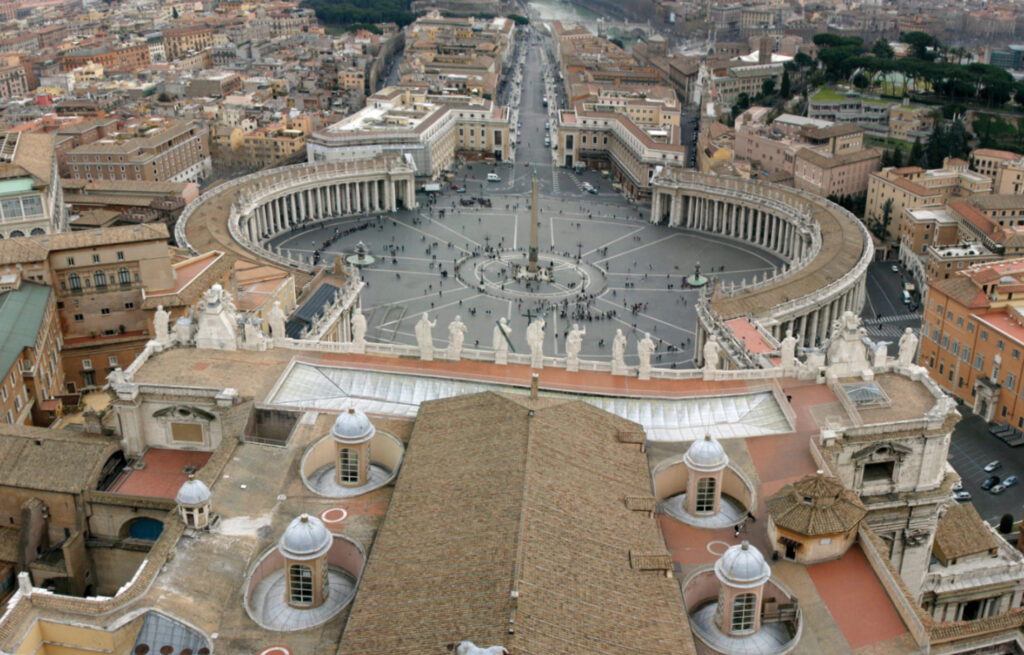
Unquestionably, the largest occult solar wheel on earth is located in the court of St. Peter at the Vatican in Rome. Notice it is made of a wheel within a wheel, with eight spokes, a common symbol of cosmic energy in paganism. Protruding from its center is an obelisk, the ancient smbol of Osiris, the solar phallic god of Egypt.
In Babylon and other cities where this worship spread, there were great temples where people went the first day of every week. This day was known as the “sun day” because it was first dedicated to the sun by ancient worshippers.
Upon meeting a sun god priest, you bowed respectfully, addressing him as “Father.” He then heard your confession and forgave your sins.
Going into the temple, you performed certain rites to protect you from evil. Priests entered, chanting to the sun god and carrying a small, round cake in a golden box, before which you knelt. By eating the cake, you received power—life and fertility. This belief led to many immoral practices. Soon, almost every nation had a modified form of sun worship.
Throughout history, Christ has fought fiercely against Satan’s counterfeit religion. At times, Satan succeeded in mixing sun worship with worship of the true God.
When Moses led the Israelites out of Egypt, sun worship in its vilest forms was the leading religion, and the bull calf became a symbol of the sun’s reproductive power. The Bible records how the Israelites succumbed to this idolatry. “They have made them a molten calf, and have worshipped it, and have sacrificed thereunto.” Ex. 32:8. For this rebellion, God severely punished His people.
Throughout their subsequent history, the Israelites seemed fatally attracted to paganism. Wicked King Ahab worshipped Baal, the Assyrian counterpart for Tammuz. 1 Kin. 16:30–33; 18:19–21,40. Ezekiel records that the women of Jerusalem were “weeping for Tammuz.” Eze. 8:14. See also Num. 25:1–5; Jud. 6:24–28; 2 Kin. 10:20–28; Jer. 44:16–23; Eze. 8:15–18. Repeatedly, Satan infiltrated God’s church, mixing pagan practices with true worship. Many times he misleads church leaders, persuading them to bring the “best” of his false religious customs into the true worship of God.
For their continual association with paganism, the Israelites were eventually exiled and scattered. By the time of Christ, only a remnant of Abraham’s descendants represented the true worship of Jehovah.
But the worst and most far reaching deception in worship happened during the rule of Rome, in the first centuries after Christ’s death. The Roman Empire was then the stronghold of sun worship in the world.
After the Roman Emperor Constantine gave Christianity preferred status, he favored Christians for government positions, which swelled the ranks of those seeking baptism. Misguided men also brought pagan practices into the early Christian church, thinking this would help convert sun worshipers to Christianity. Thus, the unconverted and the devil's pagan practices were alike baptized as Christian!
In time, this church, known as Constantine’s Church of Rome, gained authority over most other churches, and this new form of paganism spread throughout the entire Christian world. Today, this false religious system still exists.
We are not being unfair in saying that the early Roman Church brought pagan practices into Christianity. They admit it in their own words. “The church took the pagan philosophy and made it the buckler of faith against the heathen.… She took the pagan Sunday and made it the Christian Sunday.
“There is, in truth, something royal, kingly about the sun, making it a fit emblem of Jesus, the Sun of Justice.… And thus the pagan Sunday, dedicated to Balder [Norse god of Light], became the Christian Sunday, sacred to Jesus.”1
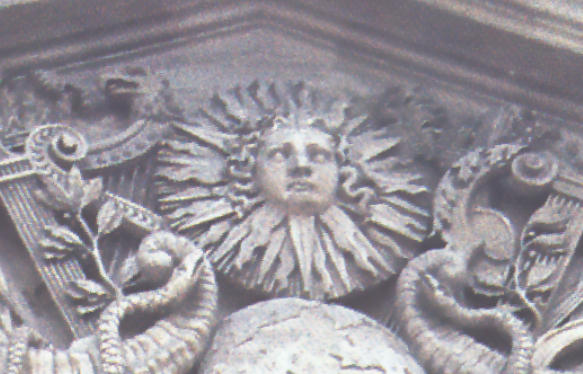
The face of Apollo, the Greek sun god, from the temple of Apollo.
How does God like pagan practices of false religion combined in His worship? He hates it with perfect hatred. The Bible refers to such practices as “abominations.” Eze. 8:7–18. God’s hatred is for a good reason. Sun worship developed to rival the worship of God’s Son, Jesus Christ. History confirms that God wants no part of sun worship mixed with His true religion. Studying the past helps us understand His present requirements.
Today, in harmony with God’s fourth commandment, a small remnant of Christians still observes the seventh-day Bible Sabbath on Saturday. But the majority of Christians worship on Sunday, the “sacred day” of paganism. If you truly understand the past and God’s bitter hatred of this false religion, you must make a choice to separate from its practices.
God’s last warning to the world is, “Come out of her [Babylon], my people, that ye be not partakers of her sins.” Rev. 18:1–5. Those who love Him will heed that call and separate from any practices of the devil’s counterfeit religion.
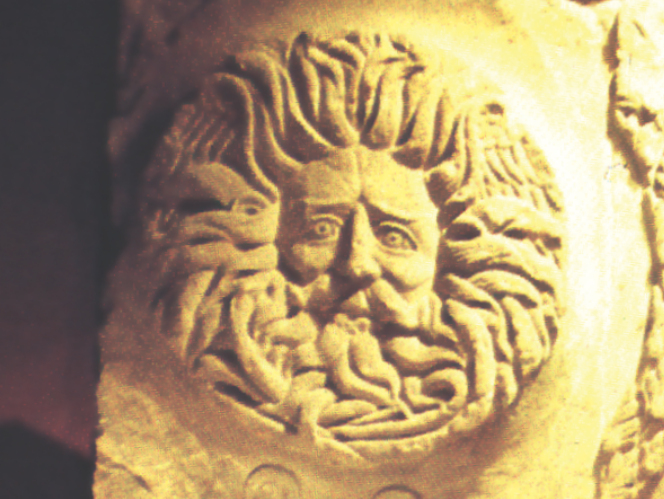
Roman sun god. Notice the horns and rays eminating in all directions. This relief is from the Roman baths in England.
“Question: Which is the Sabbath day?
“Answer: Saturday is the Sabbath day.
“Question: Why do we observe Sunday instead of Saturday?
“Answer: We observe Sunday instead of Saturday because the Catholic Church in the Council of Laodicea, transferred the solemnity from Saturday to Sunday.”
Catholic Cardinal James Gibbons, in Faith of Our Fathers, p. 111 states, “You may read the Bible from Genesis to Revelation, and you will not find a single line authorizing the sanctification of Sunday. The Scriptures enforce the religious observance of Saturday, a day which we [the Roman Catholic Church] never sanctify.”
Pope John Paul II, in Dies Domini-Dies Hominis, May 31, 1998, said this: “Wise pastoral intuition suggested to the Church the Christianization of the notion of Sunday as ‘the day of the sun,’ which was the Roman name for the day and which is retained in some modern languages. This was in order to draw the faithful away from the seduction of cults which worshipped the sun, and to direct the celebration of the day to Christ, humanity’s true ‘sun.’”
Discerning Protestants admit the same. Lutheran Dr. Augustus Neander wrote in The History of the Christian Religion and Church (1843), “The festival of Sunday, like all other festivals, was always only a human ordinance, and it was far from the intentions of the apostles to establish a divine command in this respect, far from them and from the early apostolic Church, to transfer the laws of the Sabbath to Sunday.”
Lewis’ Seventh Day Baptists in Europe and America, vol. 1, p. 29 states, “There is much evidence that the Sabbath prevailed in Wales universally until ad 1115, when the first Roman bishop was seated at St. David’s. The old Welsh Sabbath-keeping churches did not even then altogether bow the knee to Rome, but fled to their hiding places.”
John Milton says in his book Sabbath Literature, pp. 46–54, “It will surely be far safer to observe the seventh day, according to express commandment of God, than on the authority of mere human conjecture to adopt the first.”
Joseph Bingham’s Antiquities of the Christian Church, vol. II, Book XX states, “The ancient Christians were very careful in the observation of Saturday, or the seventh day.… It is plain that the Oriental churches, and the greatest part of the world, observed the Sabbath as a festival…. Anthanasius likewise tells us that they held religious assemblies on the Sabbath, not because they were infected with Judaism, but to worship Jesus, the Lord of the Sabbath. Epiphanius says the same.”
Most languages of the world still call Saturday the Sabbath. In Italian it is called Sábato, in Spanish Sábado, in Portuguese Sabádo, in French Samedi, in German Samstag, in Russian Subbota and in Polish Sobota. All these names mean “Sabbath” or “rest day” in their various languages. Except for those languages that have adopted the pagan names for the days of the week, the seventh day is still called the Sabbath, as the Lord named it at the time of Creation.
Have you ever wondered where the weekly cycle came from?
We have the yearly cycle because of the seasons, and the monthly cycle because of the moon. But nothing in nature indicates the seven-day weekly cycle. If the evolutionary theory were correct, every nationality would, by the law of averages, have come up with a different weekly cycle—some five days, some ten days, etc. But we all have the same seven-day weekly cycle because God established it during the Creation week.
Has the calendar ever been changed? Yes, but not the weekly cycle. Pope Gregory initiated a change to make up for an error in the Julian calendar by moving the date ten days forward. In October 1582, Thursday the 4th was followed by Friday the 15th in Italy and a few other countries. England changed its calendar in 1752 and Russia in 1914. Yet, the weekly cycle was never affected. During the time that England, Russia and Italy had different calendars, Sunday, Monday and Tuesday were always the same in each country.
History has exact calendar records that date back to Julius Caesar, several decades before Christ, and these records show that the weekly cycle has always remained. We have exactly the same weekly cycle today as was used in Jesus’ day, and Jesus said that the day that was called the Sabbath by the Jews, the seventh day of the week, was His day, the true Lord’s day.
Since Jesus’ day, millions of Jews have continued to keep track of the Sabbath each week. It would be impossible to change a whole nation’s day of worship overnight, then have them wake up, unified and worshiping on another day, thinking it was the Sabbath. Moreover, since it is Jesus’ day, and He has commanded us to worship on that day to show allegiance to Him, don’t you think He would preserve its identity?
Adapted from Steps to Life Sabbath Calendar, Steps to Life Ministry, Wichita, Kansas.