
By Hal and Betsy Mayer
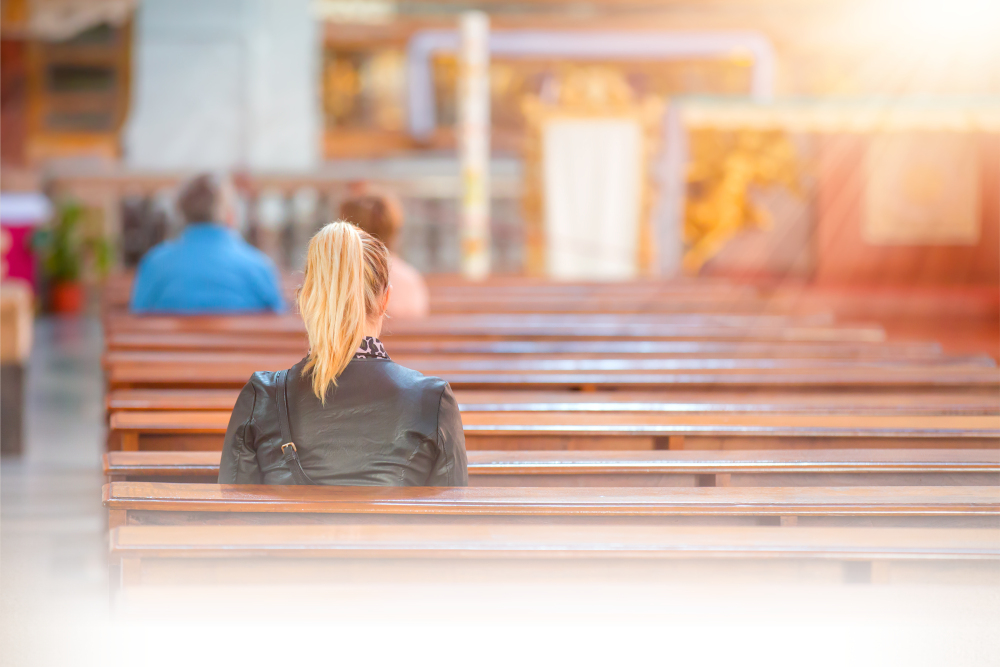
On Sunday mornings, some of the most beautiful churches in the world sit nearly empty in countries like Britain, France, and Germany. While the state pays to keep these great cathedrals open, many smaller church buildings haven’t fared as well and are now pubs and private residences. Religion has fallen on hard times in these once “Christian” nations.
According to European researchers, people rarely attend weekly services anymore. Monthly attendance hovers around 18 percent or less in many European nations.1
Demographers often refer to these nations as “post-Christian,” meaning the values and lifestyles of their citizens no longer reflect their Christian heritage.
And as Muslim birthrates and Islamic fundamentalism increase in the European Union (EU), European civil and religious leaders fear their Christian culture could soon become obsolete. These fears have been accentuated by the recent waves of new Muslim immigration. Newly elected nationalistic and right-wing political forces respond to these fears and stress the importance of returning to more traditional Christian foundations.
Yet, despite rampant secularism and a serious uptick in Muslim immigration, a few vestiges of “Christian tradition” remain. One tradition is the preference for a work-free Sunday. Not just any day of the week, but Sunday, a ritual time-honored day that used to include church attendance.
A few years ago, trade unions, social causes, and religious groups in Europe formed the European Sunday Alliance to urge the European Union to enact consistent Sunday rest laws across all EU nations. These laws would ensure that no one but essential workers are required to work on Sunday. This would necessitate closing shopping malls, limiting hours of grocery store operation, and restricting Sunday sales to only essential items such as food and medicine.
The European Sunday Alliance maintains that EU-wide Sunday rest laws would give EU citizens time for activities that promote “social cohesion”—activities like spending time with family, attending church and sporting events, and volunteering for community social projects.2
European society is coming apart at the seams, they assert, and one of the principal reasons is that it needs a social model that isn’t based on production and consumption. “We need time for the collective rituals of society, not only mass occupations like shopping.”3 In this context, collective rituals are routines that involve the majority of a society’s members such as national sporting events, and weekly or yearly religious events.
Additionally, the European Sunday Alliance claims that without Sunday rest laws, the health and safety of workers is at risk. Professor Friedhelm Nachreiner, a psychologist whose testimony in German Constitutional Court proceedings on Sunday work resulted in a ban on Sunday shop openings in Germany, stated that “Whatever set of data you look at, whatever aspects you factor in or leave aside, the result is always the same: Any person working on Sundays is negatively affected both in terms of health and safety.”4
The European Sunday Alliance has found broad support among numerous organizations and denominations, both Catholic and Protestant. It calls on Christians to work together to preserve the social and cultural fabric of Europe. However, during the formation of the European Sunday Alliance, very little concern for the religious rights of minorities was expressed.
It should be noted that working on Saturday is just as detrimental to workers’ health and safety. “Saturday and Sunday are not merely the end of the week but form the weekend—a special time for almost anybody. Its demise causes great distress,” says Dr. Jill Ebrey, a social scientist who conducts research on the social value of synchronized free time.5 Nonetheless, there are religious and cultural reasons why the European Sunday Alliance is promoting Sunday rest laws.
The roots of Europe’s preference for Sunday go back to the 4th century when Emperor Constantine elevated Christianity to official status in the Roman Empire. Constantine personally supervised the transition of the empire from its old pagan roots to a new imperial form of Christianity—Roman Catholicism.
Constantine also convened church councils to establish orthodoxy and root out heretics. He “Christianized” pagan practices to make it easier for his pagan subjects to accept Christianity. (See “When the Devil Got Baptized” in this issue for more information.)
Legally protecting a particular day of rest undermines the religious liberty of others and ignores the pluralistic nature of modern societies.
In ad 321, Constantine took the day devoted to the worship of the sun god and made it the day of Christian worship. His Sunday edict ordered that markets and public offices remain closed throughout Sunday and allowed only agricultural work.
Those who clung to the Bible Sabbath were called “Judaizers,” a loathsome appellation. Persistent Sabbath keepers were first fined, then imprisoned, and finally exiled.
For more than a millennium after Constantine’s Sunday edict, Sunday rest and eventually Sunday worship were mandated by civil law in the Holy Roman Empire, the predecessor of modern Europe. Even though Europe is now considered “post-Christian,” Sunday rest is etched deeply into the collective rhythms of Europeans.
While there is no current EU Sunday legislation, all European countries have some form of Sunday closure laws. Some countries go beyond closure laws and also prohibit home repairs and lawn mowing on Sunday. And steps are being taken towards EU-wide legislation. In December 2017, the European Economic and Social Committee, a consultative body of the European Union, issued an opinion recommending that “provisions on worker’s rest time and work-life balance should take into account, where applicable, a common weekly day of rest recognized by tradition and custom by the country or region.”6
In 2018, Poland adopted a law banning almost all trade on Sunday. It is the first time since the liberalization following the fall of communism that shopping center car parks are eerily empty on Sundays. The law was proposed by the trade union Solidarity and is supported by the pro-Catholic ruling party, Law and Justice.7
Meanwhile, the Italian government plans to ban Sunday shopping in large commercial centers “as it seeks to defend family traditions.” Speaking of liberalized Sunday trading introduced in 2012, Deputy Prime Minister Luigi Di Maio said that “this liberalization is in fact, destroying Italian families.”8
The Roman Catholic Church has the highest stakes in Sunday rest law initiatives—having the highest percentage of members in the EU. The late John Paul II, in his encyclical on Sunday worship, Dies Domini (The Lord’s Day), urged, “Christians will naturally strive to ensure that civil legislation respects their duty to keep Sunday holy.”9
In his encyclical, Laudato Si’: On Care for Our Common Home, Pope Francis surprised the world with his environmental emphasis for Sunday observance, posturing that it would motivate “to greater concern for nature and the poor.” “Sunday, like the Jewish Sabbath, is meant to be a day which heals our relationship with God…and with the world.”10
Europe is not the only place with Sunday laws. In the US, there is no national Sunday policy—but in many states, Sunday blue laws (legislation limiting commercial activities on Sunday) considerably shorten the hours allowed to conduct business. Many businesses cannot open at all on Sunday.
Ironically, while Americans are the most religious citizens among the Western nations, Sunday is not a quiet day of reflection for churchgoers. After-church activities regularly include lawn, auto, and home improvement projects and plenty of shopping, sporting events, and recreational activities.
A number of religious leaders continue to call Americans to a higher standard of Sunday observance. One US Catholic publication praised Poland’s new Sunday legislation, adding that it “could provide a constructive example for the United States.”11
Some Americans suggest that by protecting Sunday’s sacred status, we can stem the tide of national immorality. In his book Why the Ten Commandments Matter, the late Dr. D. James Kennedy asks, “Have you ever heard the old saying ‘As goes the Sabbath, so goes the nation’? It’s true. When the Sabbath [Sunday] becomes profaned and desecrated, a nation sinks deeper and deeper into the mire of sin. And that has a profound negative impact upon any country….”12
In ”The Church vs. the Mall: What Happens When Religion Faces Increased Secular Competition?” economic researchers found that after blue laws were repealed by a state, church attendance decreased by about 5 percent. About 15 percent of those who had been attending weekly religious services no longer attend as regularly. Religious contributions decline 13 percent, or about $109 per person per year. Spending by religious institutions falls by about 6.3 percent. Teenage drinking rates go up, as does marijuana use. The gap between the nonreligious and the religious taking cocaine (3 percent versus 1.5 percent) closed entirely.13
Statistics like these motivate some religious leaders to push for Sunday blue laws in an effort to keep their flocks more faithful. Yet, the moral and religious decline in “Christian” nations is not due to a lack of legislation, but to a lack of moral convictions that motivate people to act accordingly.
“The church should seek to solve the crisis of diminishing church attendance not by external legislation, but by the internal moral and spiritual renovation of her members. What many Christians need to discover today is that Christianity is not merely a cultural heritage that entails going to church from time to time, but a commitment to Christ.”14
Bible prophecies describe an intense religious persecution just before Jesus comes. A careful study of the issues reveals that it will involve enforced worship on a man-made day of rest—Sunday. Those who choose instead to honor God’s day of rest—the seventh-day Sabbath—will be threatened by the loss of civil liberties, and eventually death. (For a deeper understanding of this prophecy, please see “A Time for Choosing” in this issue.)
Sunday rest laws are not Sunday worship laws. But legally protecting Sunday as a “day of rest” could set the stage for these coercive Sunday worship laws mentioned in Bible prophecy. Ensuring that workers and families have a day of rest is praiseworthy. But legislating a particular day of rest undermines the religious liberty of others and ignores the pluralistic nature of modern societies.
“Being Christian in Western Europe,” Pew Research Center, www.pewforum.org, May 29, 2018.
European Sunday Alliance, www.europeansundayalliance.eu
“Europe: 65 Organizations-Work-Free-Sunday Alliance,” Catholic News World, www.catholicnewsworld.com, Aug. 15, 2011.
Ibid.
Ibid.
“Proposal for a Directive of the European Parliament and of the Council on work-life balance for parents and carers and repealing Council Directive 2010/18/EU’ [COM(2017) 253 final–2017/0085 (COD)],” Official Journal of the European Union, April 11, 2018.
“Poland’s Sunday trading ban takes effect,” The Guardian, March 11, 2018.
“New Italian government plans to curb Sunday shopping – Di Maio,” Reuters, Sept. 9, 2018.
John Paul II, Dies Domini, Section 67.
Pope Francis, Laudato Si, Section 237, emphasis supplied.
“Taking Sunday Seriously–Poland Leads the Way,” National Catholic Register, April 2, 2018.
Dr. D. James Kennedy, Why the Ten Commandments Matter, Faithworks Publishing, 2006, p. 71.
David R. Francis, “Maybe ‘Blue Laws’ Weren’t So Bad,” Christian Science Monitor, Sept. 11, 2006.
Dr. Samuele Bacchiocchi, A Look at the Pope’s Pastoral Letter, Dies Domini, p. 17.
© iStockphoto.com

Hal Mayer is the speaker/director of Keep the Faith Ministry, a monthly audio ministry on end-time issues. www.ktfministry.org. His wife, Betsy, is the managing editor of Last Generation magazine.