
By Ralph Larson
Imagine attending a baptismal service at a church that practices baptism by immersion. Surprisingly, when the pastor calls the candidates forward, you notice the devil standing in line in a baptismal gown!
As shocking as it seems, something like this really happened in history! It started a long time ago when God’s favorite angel rebelled and became the devil.
“And there was war in Heaven: Michael and His angels fought against the dragon; and the dragon fought and his angels, and prevailed not.… And the great dragon was cast out, that old serpent, called the Devil, and Satan, which deceiveth the whole world: he was cast out into the earth, and his angels were cast out with him.” Rev. 12:7–9. But the war wasn’t over! In Genesis chapter 3, Satan enlisted allies in his war by deceiving Adam and Eve.
In His mercy, God didn’t leave the human race. He promised the serpent (Satan in disguise), “And I will put enmity between thee and the woman, and between thy seed and her seed; it shall bruise thy head, and thou shalt bruise his heel.” Gen. 3:15. Realizing salvation was coming to the fallen race through a child born of a woman, Satan worked to counterfeit this event.
Satan obscured true worship of God and the Messiah’s birth through an empire called Babel or Babylon, where men rebelled against God and built a tower to defy His authority. Gen. 11:1–9. Nimrod, Noah’s great grandson, was founder and king of this great city. Gen. 10:8–10. However, unlike his great grandfather who worshiped the true God, Nimrod engaged in idolatrous practices, complete with human sacrifices.
History reveals Nimrod had a beautiful but evil wife called Semiramus, and the Babylonians worshiped them both as gods. When Nimrod died, Semiramus controlled her subjects by claiming he had gone to live in the sun, so people could still honor him by worshiping the sun. She added that when she died, she would go live in the moon, and people should pray to her there.
Later, on Dec. 25, this evil queen gave birth to an illegitimate child—Tammuz—who she claimed had been conceived through the sun’s rays. Believing Tammuz was Nimrod’s child, people worshiped him too. When Tammuz was killed while hunting, people continued to worship him, believing he lived among the stars. Tammuz’s birthday was the greatest holiday of the year.
Gradually, this false religion became the devil’s great masterpiece. What was it like?
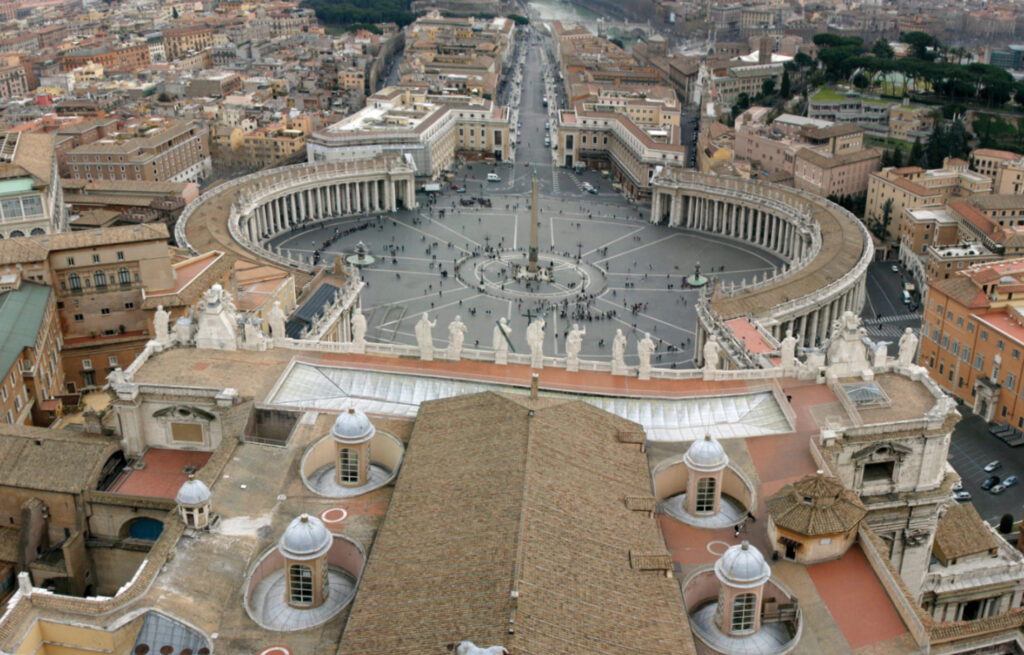
Unquestionably, the largest occult solar wheel on earth is located in the court of St. Peter at the Vatican in Rome. Notice it is made of a wheel within a wheel, with eight spokes, a common symbol of cosmic energy in paganism. Protruding from its center is an obelisk, the ancient smbol of Osiris, the solar phallic god of Egypt.
In Babylon and other cities where this worship spread, there were great temples where people went the first day of every week. This day was known as the “sun day” because it was first dedicated to the sun by ancient worshippers.
Upon meeting a sun god priest, you bowed respectfully, addressing him as “Father.” He then heard your confession and forgave your sins.
Going into the temple, you performed certain rites to protect you from evil. Priests entered, chanting to the sun god and carrying a small, round cake in a golden box, before which you knelt. By eating the cake, you received power—life and fertility. This belief led to many immoral practices. Soon, almost every nation had a modified form of sun worship.
Throughout history, Christ has fought fiercely against Satan’s counterfeit religion. At times, Satan succeeded in mixing sun worship with worship of the true God.
When Moses led the Israelites out of Egypt, sun worship in its vilest forms was the leading religion, and the bull calf became a symbol of the sun’s reproductive power. The Bible records how the Israelites succumbed to this idolatry. “They have made them a molten calf, and have worshipped it, and have sacrificed thereunto.” Ex. 32:8. For this rebellion, God severely punished His people.
Throughout their subsequent history, the Israelites seemed fatally attracted to paganism. Wicked King Ahab worshipped Baal, the Assyrian counterpart for Tammuz. 1 Kin. 16:30–33; 18:19–21,40. Ezekiel records that the women of Jerusalem were “weeping for Tammuz.” Eze. 8:14. See also Num. 25:1–5; Jud. 6:24–28; 2 Kin. 10:20–28; Jer. 44:16–23; Eze. 8:15–18. Repeatedly, Satan infiltrated God’s church, mixing pagan practices with true worship. Many times he misleads church leaders, persuading them to bring the “best” of his false religious customs into the true worship of God.
For their continual association with paganism, the Israelites were eventually exiled and scattered. By the time of Christ, only a remnant of Abraham’s descendants represented the true worship of Jehovah.
But the worst and most far reaching deception in worship happened during the rule of Rome, in the first centuries after Christ’s death. The Roman Empire was then the stronghold of sun worship in the world.
After the Roman Emperor Constantine gave Christianity preferred status, he favored Christians for government positions, which swelled the ranks of those seeking baptism. Misguided men also brought pagan practices into the early Christian church, thinking this would help convert sun worshipers to Christianity. Thus, the unconverted and the devil's pagan practices were alike baptized as Christian!
In time, this church, known as Constantine’s Church of Rome, gained authority over most other churches, and this new form of paganism spread throughout the entire Christian world. Today, this false religious system still exists.
We are not being unfair in saying that the early Roman Church brought pagan practices into Christianity. They admit it in their own words. “The church took the pagan philosophy and made it the buckler of faith against the heathen.… She took the pagan Sunday and made it the Christian Sunday.
“There is, in truth, something royal, kingly about the sun, making it a fit emblem of Jesus, the Sun of Justice.… And thus the pagan Sunday, dedicated to Balder [Norse god of Light], became the Christian Sunday, sacred to Jesus.”1
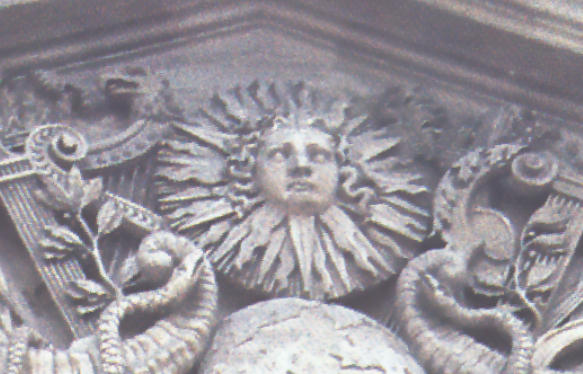
The face of Apollo, the Greek sun god, from the temple of Apollo.
How does God like pagan practices of false religion combined in His worship? He hates it with perfect hatred. The Bible refers to such practices as “abominations.” Eze. 8:7–18. God’s hatred is for a good reason. Sun worship developed to rival the worship of God’s Son, Jesus Christ. History confirms that God wants no part of sun worship mixed with His true religion. Studying the past helps us understand His present requirements.
Today, in harmony with God’s fourth commandment, a small remnant of Christians still observes the seventh-day Bible Sabbath on Saturday. But the majority of Christians worship on Sunday, the “sacred day” of paganism. If you truly understand the past and God’s bitter hatred of this false religion, you must make a choice to separate from its practices.
God’s last warning to the world is, “Come out of her [Babylon], my people, that ye be not partakers of her sins.” Rev. 18:1–5. Those who love Him will heed that call and separate from any practices of the devil’s counterfeit religion.
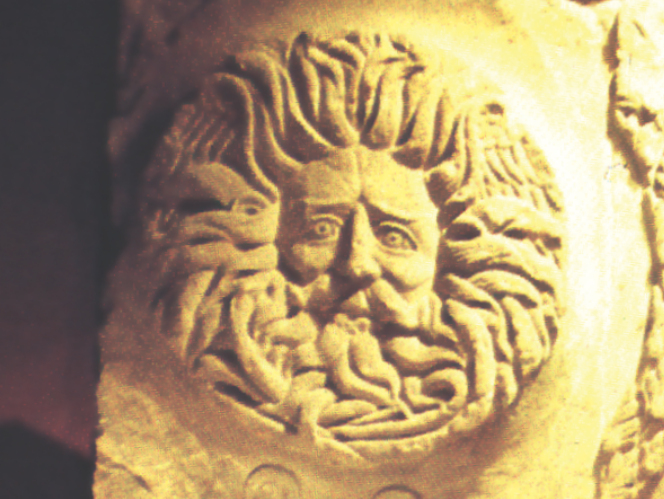
Roman sun god. Notice the horns and rays eminating in all directions. This relief is from the Roman baths in England.
“Question: Which is the Sabbath day?
“Answer: Saturday is the Sabbath day.
“Question: Why do we observe Sunday instead of Saturday?
“Answer: We observe Sunday instead of Saturday because the Catholic Church in the Council of Laodicea, transferred the solemnity from Saturday to Sunday.”
Catholic Cardinal James Gibbons, in Faith of Our Fathers, p. 111 states, “You may read the Bible from Genesis to Revelation, and you will not find a single line authorizing the sanctification of Sunday. The Scriptures enforce the religious observance of Saturday, a day which we [the Roman Catholic Church] never sanctify.”
Pope John Paul II, in Dies Domini-Dies Hominis, May 31, 1998, said this: “Wise pastoral intuition suggested to the Church the Christianization of the notion of Sunday as ‘the day of the sun,’ which was the Roman name for the day and which is retained in some modern languages. This was in order to draw the faithful away from the seduction of cults which worshipped the sun, and to direct the celebration of the day to Christ, humanity’s true ‘sun.’”
Discerning Protestants admit the same. Lutheran Dr. Augustus Neander wrote in The History of the Christian Religion and Church (1843), “The festival of Sunday, like all other festivals, was always only a human ordinance, and it was far from the intentions of the apostles to establish a divine command in this respect, far from them and from the early apostolic Church, to transfer the laws of the Sabbath to Sunday.”
Lewis’ Seventh Day Baptists in Europe and America, vol. 1, p. 29 states, “There is much evidence that the Sabbath prevailed in Wales universally until ad 1115, when the first Roman bishop was seated at St. David’s. The old Welsh Sabbath-keeping churches did not even then altogether bow the knee to Rome, but fled to their hiding places.”
John Milton says in his book Sabbath Literature, pp. 46–54, “It will surely be far safer to observe the seventh day, according to express commandment of God, than on the authority of mere human conjecture to adopt the first.”
Joseph Bingham’s Antiquities of the Christian Church, vol. II, Book XX states, “The ancient Christians were very careful in the observation of Saturday, or the seventh day.… It is plain that the Oriental churches, and the greatest part of the world, observed the Sabbath as a festival…. Anthanasius likewise tells us that they held religious assemblies on the Sabbath, not because they were infected with Judaism, but to worship Jesus, the Lord of the Sabbath. Epiphanius says the same.”
Image credit: © Shutterstock.com
Catholic World, March 1894, p. 809.

Adapted from His Mighty Love, Twenty-one Evangelistic Sermons, by Ralph Larson, who was an author and retired minister. Published by Teach Services, Inc. Used by permission.