
Adapted By Gillian Bethel
Nickolai Panchuk stood in front of the warden’s office for the second time since his arrival at a Russian prison camp. In their introductory interview earlier that week, he’d told the warden he would cooperate with his orders. Afterwards, he realized he’d forgotten to mention something important that might be a problem.
It was a problem. On Saturday, because he didn’t go to work, he was beaten heavily by the guard in charge of his barracks—a man named Yuri. But still he didn’t go, so the guard took him to the steely-eyed warden. “It’s God’s holy day. I cannot work on the seventh-day Sabbath,” Nickolai explained.
The warden had no sympathy with religious convictions. “The consequences will be severe,” he replied icily.
After a violent whipping by the warden, Nickolai dragged himself back to his barracks. All week, he worried and prayed about what would happen the next Sabbath, but by Friday night, his faith was strong.
When Nickolai again declined to work, the furious warden took him to an empty wooden box in a barn. It didn’t look to be more than a yard long or high and half a yard wide.
“Get in!” the warden ordered. “Sit down.”
As the lid slammed over him, a shower of dust choked the young man.
“Hope you like your new home!” the warden called as he left.
Nickolai could breathe through the cracks in the box, but he couldn’t stand up, lie down, or straighten his legs.
“Please, Lord, don’t let me become discouraged,” he prayed. “Don’t let my faith in You fail.”
Nickolai had been a church pastor in Kiev, Ukraine, which was then part of the USSR. He had cared for 11 small congregations, forming new ones as the gospel spread. The KGB had confronted Nickolai several times asking for his members’ names, but he wouldn’t cooperate. Finally, he was arrested, and after all their interrogation methods failed, he was sentenced to hard labor in Siberia.
Nickolai believed God had a purpose for his life even in prison. He appeared to be the only Christian in this remote camp—so remote there were no walls or guard towers. There was nowhere to escape to on the vast Russian steppes! He prayed that if even one life was changed through his presence there, it would be enough.
But the box was a challenge. He was given water, but no food. His cramped legs caused him agony as the days went by; then finally they wouldn’t move. They just throbbed with a dull pain. He was not let out for the bathroom and was mercilessly bitten by flies and mosquitoes. On the tenth day, a Monday, Yuri unlocked the box and helped him out. He couldn’t stand or walk at first, so he lay on a pile of straw, massaging his legs until circulation painfully returned. Yuri brought him borscht, but he didn’t dare eat it all after a 10-day fast.
By Wednesday, Nickolai was feeling strong enough to return to his barracks, and on Thursday and Friday he went back to his work in the woodshop. But on Sabbath, he again refused to work and was put back in the box for another 10 days.
Neither Nickolai nor the warden would give in, so this became the routine. The only consolation was that he was able to keep the fourth commandment, showing love and respect for his Creator by resting from labor and worshiping Him—in the box.
How did Nickolai endure the long, miserable days and nights in the box without blaming God for not caring? How did he hold on to his faith? Nickolai had made a commitment to God that he would be true to Him whatever happened. Whenever he was tempted to feel sorry for himself, he would remember what Jesus suffered on his behalf to give him eternal life. He would talk to God, sing hymns, and recall encouraging Bible verses until his peace and faith were restored.
Yuri took pity on Nickolai and started bringing him bread daily. He even supplied blankets in the winter. He moved the box away from drafts and heaped straw around it for warmth, yet it was still surprising that Nickolai survived.
Incredibly, this cycle of torture continued for two years!
One day, a visiting colonel walked into the barn with the warden and asked about the box. He was astounded to learn what the warden was doing to Nickolai and ordered Yuri to open the box.
“Do you mean to tell me that you’ve been locking this man up in this crate for two years, and it hasn’t done any good?” he said to the warden. “Did it ever occur to you that there may be a good reason he isn’t following your orders?”
The colonel talked with Nickolai, then arranged for him to have a job hauling water to the camp from a spring. If Nickolai could haul enough water during six days to supply the seventh also, he could have the Sabbath off. The colonel’s kindness touched Nickolai. It was a tall order, but he was sure God would help him do it.
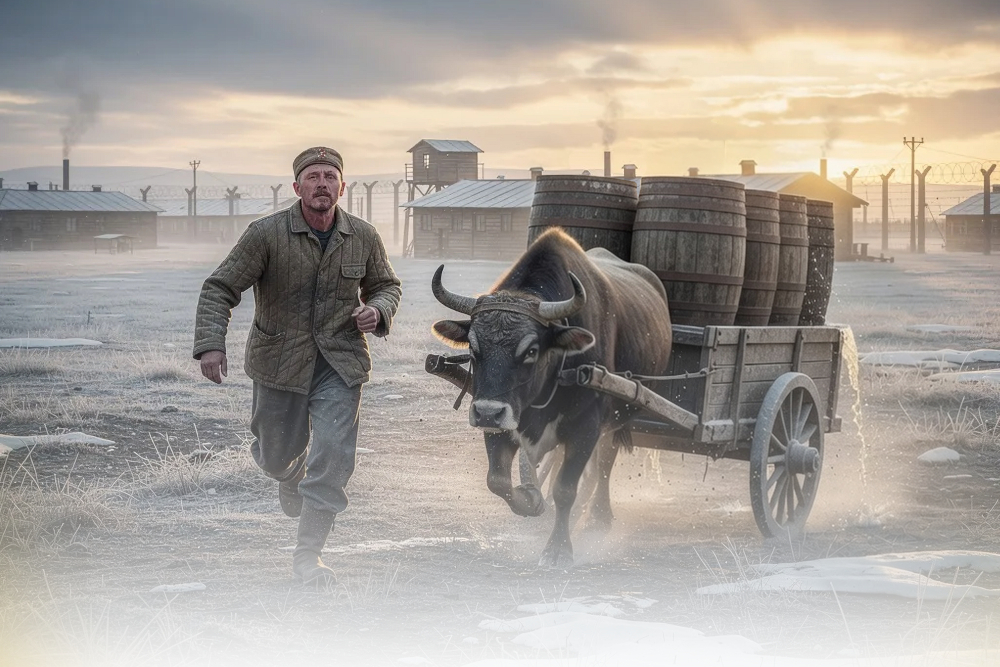
But there was a problem no one had considered: old Maksim, the ox who pulled the water cart. Maksim chose his own pace, and no one could make him go faster if he didn’t want to!
It was about 1.5 miles to the spring. Nickolai calculated how many extra trips they needed each day to reach the goal, and they worked from before sunrise until after dark. By the first Thursday night, Nickolai was in despair. There was no way to get enough water by Friday sunset. The ox went too slowly. Nickolai had done his best to get extra water, but he’d failed. He prayed late into the night. Eventually, he gave the whole problem to God and fell asleep.
When Friday morning came, Nickolai couldn’t believe his senses! Maksim was impatient to go and set off at a run. Nickolai could barely keep up with him! All day, the ox worked frenziedly, so by sunset they actually had enough water for the Sabbath. It was a miracle! Nickolai recalled the Bible verse, “‘Not by might nor by power, but by My Spirit,’ says the Lord of hosts.” Zech. 4:6.
On Fridays, the old ox became a different creature and Nickolai had to run to keep up with him!
The miracle was repeated weekly, not just for the rest of Nickolai’s time at the camp, but even after he left! All week, Maksim plodded, but on Fridays he ran all day! It impressed the whole camp. Nickolai was able to start a small Bible study group in time, and Petya, the cook, asked for baptism. Even the warden softened a little towards Nickolai.
When the colonel returned after eight years, he was so impressed that he surprised Nickolai by signing his release forms. “You have shown us all what a man of character can do when he’s motivated,” he said, “and you have shown what devotion can do for a man that loves his God.”
And God had shown how “all things work together for good to those who love God” (Rom. 8:28) if they trust Him patiently, despite harrowing circumstances.
Adapted from The Miracle of the Seventh-day Ox by Bradley Booth.
Image credit: © Shutterstock.AI

Gillian Bethel is the associate editor of Last Generation magazine.