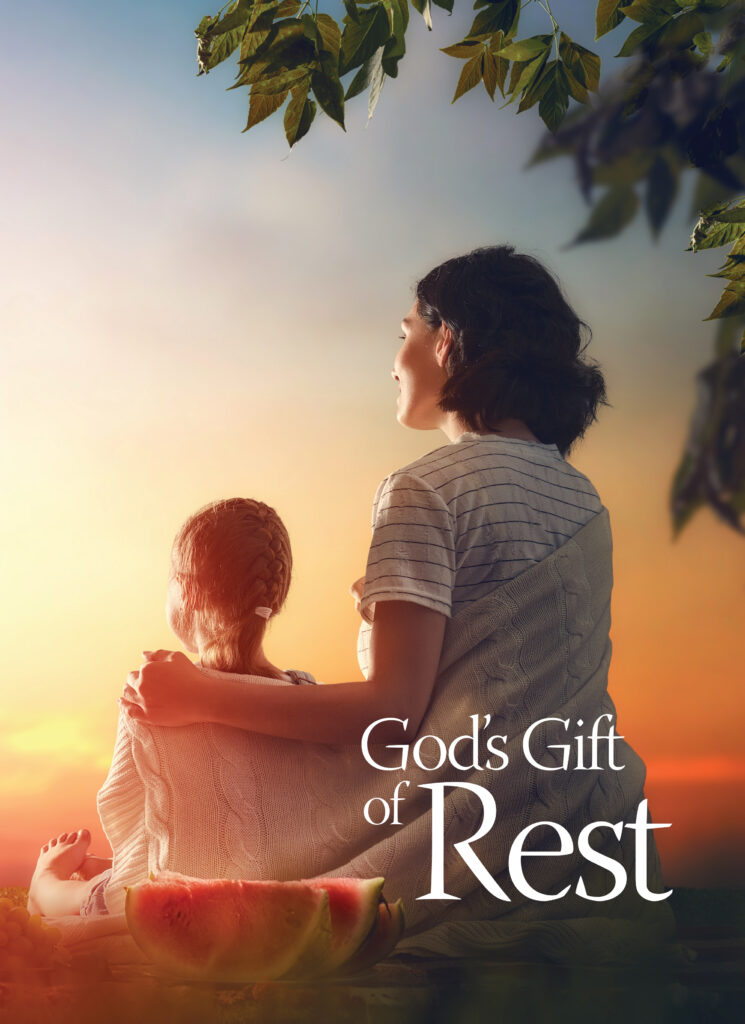
So much was lost when Adam and Eve disobeyed God and forfeited their ownership of the world to Lucifer—God’s Enemy. Their garden home, face-to-face communion with God and relationship of trust with each other and nature were only a few of these losses.
Yet to us, sons and daughters of Adam and Eve, we’ve been given a lingering taste of Eden, a promise of a Redeemer. We have retained two special gifts from Eden—the sacred marriage bond and the Sabbath.
Hallowed and set apart as a memorial of His creative power, God intended the Sabbath to be a sanctuary in time—a time for the highest spiritual reflection and intimate communion with His children. Fallen man still needs those 24 hours apart from the crushing cares of this life. He needs the spiritual, emotional and physical renewal of God’s re-creative power promised by the Sabbath. And, he needs the promise of Eden restored in the New Earth.
Today many individuals believe that the Sabbath was made for the Jews alone, because God gave the law to the Jews. But the Sabbath was a gift to mankind long before the days of Abraham.
1. When was the Sabbath first given to mankind? Genesis 2:1–3
2. When was the Sabbath command given to the children of Israel? Exodus 19:20; 20:8–11
3. To Whom does the seventh day belong? Exodus 20:10
The everlasting God of heaven descended to Mount Sinai and proclaimed with His own voice the Ten Commandments, which represent the foundation of our duty to God and our fellow human beings. No reasonable Christian would insist that the command to honor parents was given only to the Jews or that only Jewish people were forbidden to commit murder. The Sabbath command was just as universally given to the human race as the other great moral principles of God’s law.
The same Lord, Who gave the Sabbath on Sinai, also gave the Sabbath at Creation.
1. With what specific word did God begin the Sabbath command? Exodus 20:8
2. What other reason did God give the Israelites for keeping His Sabbath? Deuteronomy 5:15
3. In what practical way did God teach them about the importance of Sabbath keeping? Exodus 16:22–30
Over time, the Sabbath was forgotten by most of the world. Images of creation were worshipped instead of the Creator. So God chose Abraham and his descendants to preserve knowledge of His law. Yet, after being enslaved for 400 years, even Abraham’s descendants had forgotten the Sabbath.
One of the greatest controversies among Christians today involves keeping the Ten Commandments. Weren’t they nailed to the cross? Aren’t Christians practicing legalism if they try to keep them? Let’s examine what the Bible says about God’s law.
1. When we are called before the judgment seat of God, by what standard will we be judged? Ecclesiastes 12:13, 14; James 2:10–12
Many feel that by taking the name Christian and doing charitable acts, they will pass the scrutiny of the judgment. But according to Jesus, not everyone who claims the name of Christ will be accepted. Only those who do the will of His Father as He did will enter the kingdom of Heaven. Matthew 7:21–23.
2. How does John describe those who claim to know God but do not keep His commandments? 1 John 2:4
3. If we claim to abide in the Lord, Whose example are we to follow? 1 John 2:6
4. What was Christ’s example in reference to the law? John 15:10
5. How long did Christ proclaim the law would last? Matthew 5:18
6. Do Jesus’ commandments still apply to us today? Hebrews 13:8
Paul asked, “Do we then make void the law through faith? God forbid: yea, we establish the law.” Romans 3:31. Faith in Christ does not result in throwing out the law! It enables God to write the law within our hearts. Hebrews 8:10. When we want to show God how much we love and trust Him, we will gladly do what He asks. “Love is the fulfilling of the law.” Romans 13:10. “O how I love thy law! it is my meditation all the day.” Psalm 119:97.
1. Which day is the Sabbath of the Lord? Exodus 20:10
2. What day of the week is the seventh day?
Traditionally, calendars have shown Sunday as the first day of the week, Monday as the second, etc., through Saturday, the seventh. However, some calendars now show Monday as the first day.
Webster’s dictionary defines Sabbath as the “seventh day, Saturday, the seventh day of the week.” Webster’s New Twentieth Century Dictionary, Unabridged 2nd ed., 1973. But some dictionaries also define Sabbath as Sunday, the first day of the week. The American Heritage Dictionary of the English Language, 3rd ed., 1992. Therefore, it may be confusing to identify the seventh day. Let’s examine the Bible.
3. What three days are described during the week of Jesus’ death? Mark 15:42–47; 16:1, 2, 6; Luke 23:54–56; 24:1
The Bible describes the preparation day or day before the Sabbath, the Sabbath and the first day. Today, we say Friday, Saturday and Sunday. Virtually all Christians celebrate these days during Easter. Jesus died on the preparation day (Friday) and was buried. He remained in the tomb through the Sabbath (Saturday). He then rose on the first day (Sunday). But some wonder, haven’t calendars changed? See “Has the Calendar Changed?” in this issue for a detailed answer.
4. When does the Sabbath begin and end? Genesis 1:31–2:3
Biblical days began and ended at sunset. The seventh-day Sabbath is observed from sunset to sunset. The period for the Sabbath is still the same.
5. What does God promise those who keep His Sabbath and covenant? Isaiah 56:1–8
6. How else is the Sabbath described? Leviticus 23:3
7. What are Christians encouraged not to forsake as the Second Coming approaches? Hebrews 10:25
The Sabbath is a day of fellowship with the Lord and with our brothers and sisters in Christ. Convocation in Hebrew implies a meeting of people. So, part of worshiping on the Sabbath day involves meeting together with other believers.
1. Who is Lord of the Sabbath? Mark 2:27, 28
2. Where did Jesus go, and what was His custom on the Sabbath? Luke 4:16
3. What happened on the Sabbath during the weekend of Christ’s death? Luke 23:52–56
During His life, Jesus attended and participated in Sabbath worship. Even in death, Jesus kept the Sabbath as He rested in the tomb.
1. How did Christ show that the Sabbath would remain sacred after His resurrection? Matthew 24:20
This prophecy was not fulfilled until the destruction of Jerusalem in ad 70, thirty-nine years after Jesus’ death and resurrection. Yet, He commanded the disciples to pray that they would not have to flee on the Sabbath. If He had meant Sunday, certainly He would have explained to the disciples that the day of worship would be changed.
2. What did Paul do on the Sabbath day? Acts 17:1, 2; 18:4
3. When did the Gentiles gather together to hear Paul preach the Word of God? Acts 13:42–44
After Christ ascended, the disciples and apostles continued to keep the whole law of God, including the seventh-day Sabbath.
4. In the New Earth, what will we continue to do? Isaiah 66:22, 23
Examining this topic in your Bible may bring you to the stunning realization that you must take a stand. The Word of God is like a sharp sword, cutting through our past understanding or favorite theories. Hebrews 4:12.
But the Word also has a promise for those who determine with all their hearts that they will keep the seventh-day Sabbath: “If thou…call the Sabbath a delight, the holy of the Lord,…I will cause thee to ride upon the high places of the earth, and feed thee with the heritage of Jacob thy father: for the mouth of the Lord hath spoken it.” Isaiah 58:13, 14. Would you like to have this promise fulfilled in your life?
I understand that God expects us to live by “every word that proceedeth out of the mouth of God” and not man-made traditions. Matthew 4:4. I also recognize that to break one of God’s Ten Commandments is to break them all. James 2:10, 11. Therefore, I choose to keep the seventh-day Sabbath as a sign of my allegiance to God Who made Heaven and Earth. Ezekiel 20:20; Revelation 14:7, 12.