
By Ellen G. White
During His childhood and youth, Jesus had worshipped among His brethren in the synagogue at Nazareth. Since the opening of His ministry He had been absent from them. As He again appeared among them, their interest and expectation were excited to the highest pitch. Upon this Sabbath Jesus was requested to take part in the service. He “stood up for to read. And there was delivered unto him the book of the prophet Esaias.” Luke 4:16, 17.
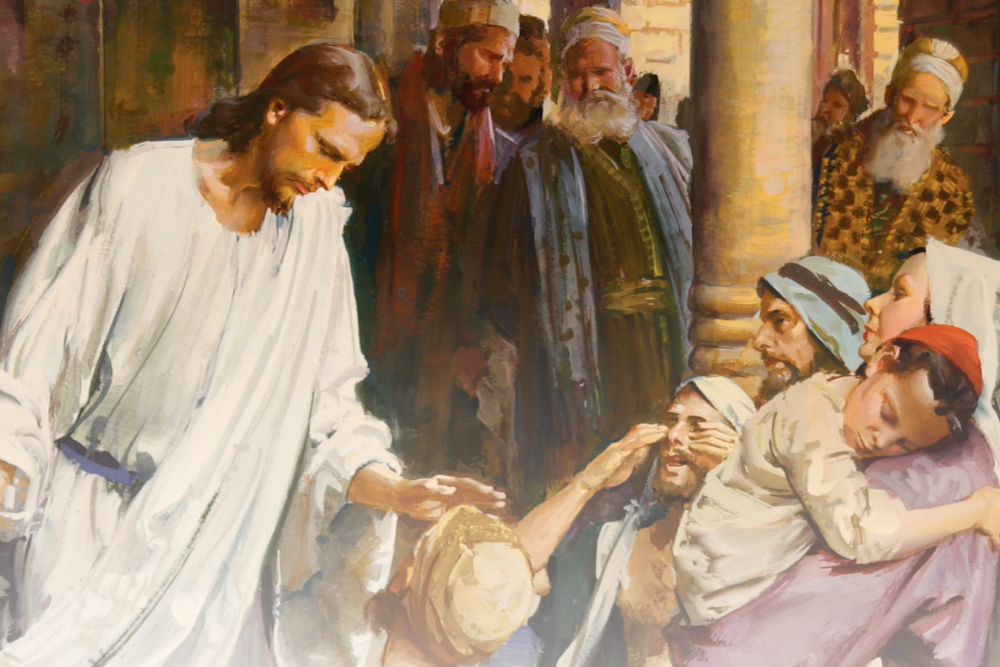
Jesus was at Jerusalem. Walking alone, in apparent meditation and prayer, He came to the [Bethesda] pool. He longed to exercise His healing power and make every sufferer whole. But it was the Sabbath day. Multitudes were going to the temple for worship, and He knew that such an act of healing would so excite the prejudice of the Jews as to cut short His work.
But the Savior saw one case of supreme wretchedness. It was that of a man who had been a helpless cripple for 38 years. Jesus does not ask this sufferer to exercise faith in Him. He simply says, “Rise, take up thy bed, and walk.” But the man’s faith takes hold upon the word. Springing to his feet, he finds himself an active man.
Jesus was brought before the Sanhedrin to answer the charge of Sabbath breaking. Whoever dared to condemn the rabbinical requirements, or attempt to lighten the burdens they had brought upon the people, was regarded as guilty not only of blasphemy, but of treason.
Jesus had come to “magnify the law and make it honorable.” He was not to lessen its dignity, but to exalt it. He had come to free the Sabbath from those burdensome requirements that had made it a curse instead of a blessing.
For this reason He had chosen the Sabbath upon which to perform the act of healing in Bethesda. A wise purpose underlay every act of Christ’s life on Earth. Everything He did was important in itself and in its teaching. Among the afflicted ones at the pool He selected the worst case upon whom to exercise His healing power, and bade the man carry his bed through the city in order to publish the great work that had been wrought upon him. This would raise the question of what it was lawful to do on the Sabbath, and would open the way for Him to denounce the restrictions of the Jews in regard to the Lord’s day, and to declare their traditions void. Jesus stated to them that the work of relieving the afflicted was in harmony with the Sabbath law.
Upon another Sabbath, as Jesus entered a synagogue, He saw there a man who had a withered hand. The Pharisees watched Him, eager to see what He would do.
Jesus bade the afflicted man stand forth and then asked, “Is it lawful to do good on the Sabbath days, or to do evil? To save life, or to kill?” It was a maxim among the Jews that a failure to do good, when one had the opportunity, was to do evil; to neglect to save life was to kill. Thus Jesus met the rabbis on their own ground. “But they held their peace. And when He had looked round about on them with anger, being grieved for the hardness of their hearts, He saith unto the man, Stretch forth thine hand. And he stretched it out: and his hand was restored whole as the other.” Mark 3:4, 5.
When questioned, “Is it lawful to heal on the Sabbath days?” Jesus answered, “What man shall there be among you, that shall have one sheep, and if it fall into a pit on the Sabbath day, will he not lay hold on it, and lift it out? How much then is a man better than a sheep? Wherefore it is lawful to do well on the Sabbath days.” Matthew 12:10–12.
In the healing of the withered hand, Jesus condemned the custom of the Jews and left the fourth commandment standing as God had given it. “It is lawful to do well on the sabbath days,” He declared.
“The Sabbath was made for man, and not man for the Sabbath,” Jesus said. The institutions that God has established are for the benefit of mankind. “For all things are for your sakes.…” “Whether Paul, or Apollos, or Cephas, or the world, or life, or death, or things present, or things to come; all are yours; and ye are Christ’s; and Christ is God’s.” 2 Corinthians 4:15; 1 Corinthians 3:22, 23.
“Therefore the Son of man is Lord also of the Sabbath.” Mark 2:28. These words are full of instruction and comfort. Because the Sabbath was made for man, it is the Lord’s day. It belongs to Christ. For “all things were made by Him; and without Him was not any thing made that was made.” John 1:3.
Since He made all things, He made the Sabbath. By Him it was set apart as a memorial of the work of Creation. It points to Him as both the Creator and the Sanctifier. It declares that He who created all things in Heaven and in Earth, and by whom all things hold together, is the head of the church, and that by His power we are reconciled to God.
Christ did not yield up His life till He had accomplished the work which He came to do, and with His parting breath He exclaimed, “It is finished.” John 19:30.
At last Jesus was at rest. The long day of shame and torture was ended. As the last rays of the setting sun ushered in the Sabbath, the Son of God lay in quietude in Joseph’s tomb. His work completed, His hands folded in peace, He rested through the sacred hours of the Sabbath day.
In the beginning the Father and the Son had rested upon the Sabbath after Their work of Creation. “The morning stars sang together, and all the sons of God shouted for joy.” Job 38:7.
Now Jesus rested from the work of redemption; and though there was grief among those who loved Him on Earth, yet there was joy in Heaven. When there shall be a “restitution of all things, which God hath spoken by the mouth of all His holy prophets since the world began” (Acts 3:21), the Creation Sabbath, the day on which Jesus lay at rest in Joseph’s tomb, will still be a day of rest and rejoicing.
© Pacific Press

Ellen G. White (1827–1915) was a Christian author and speaker whose inspirational writings have been translated worldwide. Excerpted from The Desire of Ages, selected chapters.