By Jeff Wehr
Confusion about what happens to a soul at the time of death has led many sincere Christians to believe they can assist their departed loved ones towards a happier and holier state in the next life through prayer, almsgiving, and mass. Some religions teach that most people don’t finish getting ready for heaven in this life and need another chance after they die. The solution is purgatory—an opportunity for departed souls to be perfected before encountering a holy God who cannot allow sin in His presence.
The Latin term purgatio means “to cleanse or purify” and is understood to be a state of the soul after death where final purification takes place before entering paradise. Mark, who was raised Catholic, was taught that purgatory was a real place where you might burn for 100,000 years before you were good enough to go to heaven. He was taught that if your loved ones prayed, had masses said for you, or donated money to the church, your time in purgatory could be shortened. And while no one looked forward to purgatory, it could be endured because eventually their souls would make it to heaven. It was certainly better than the fires of eternal hell, from which there was no escape.
Does the Bible teach that we have a second chance to get it right if we miss the opportunity on earth? Can we use our money, our good works, or our prayers to help our dead loved ones prepare themselves to enter heaven?
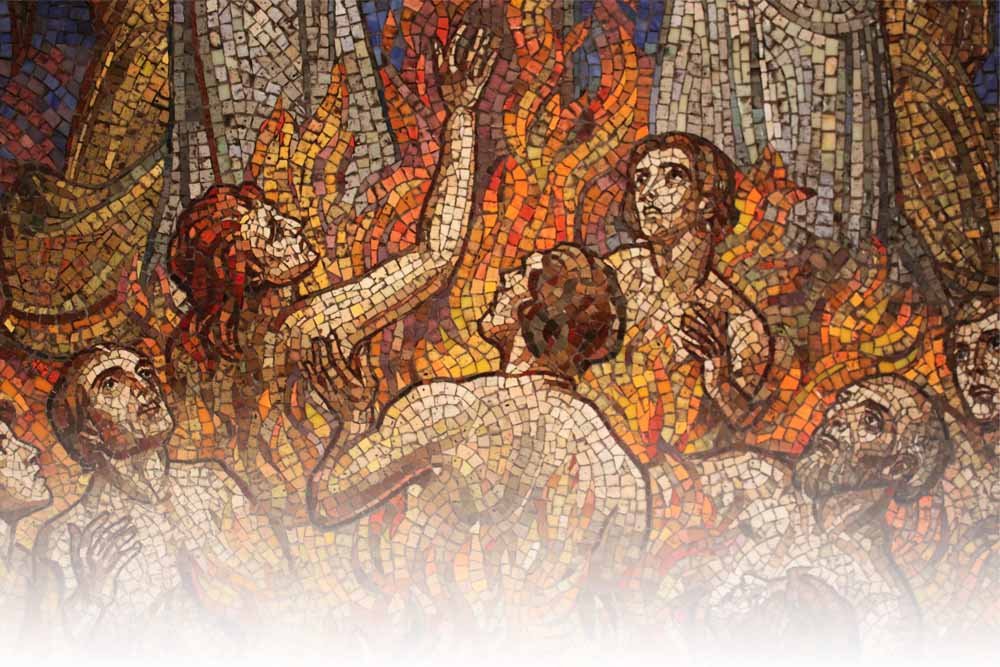
Artists paint purgatory as a most horrible place somewhere between heaven and hell. Yet the Bible is completely silent on the existence of such an intermediary place.
For this reason, the writings of Maccabees are used to justify the concept of purgatory. All four books of Maccabees have been rejected as uninspired by most Christians, but two of these four books were accepted by the Roman Church and placed in the Douay-Rheims Bible.1
Purgatory can be an appealing idea for people who want to live in sin and die in their sins and yet get to heaven. But in the end they will be disappointed, for the Bible teaches, “Be not deceived; God is not mocked: for whatsoever a man soweth, that shall he also reap.” Gal. 6:7. God “will render to every man according to his deeds.” Rom. 2:6.
This present life is the spiritual sowing time. Now is the time to get right with God: “Behold, now is the accepted time; behold, now is the day of salvation.” 2 Cor. 6:2.
But you say, “I have already given money to my church for my dead relatives. Does it not relieve their sufferings in purgatory?” The Bible certainly does not support such a notion. Psalm 49:7 reads, “None of them can by any means redeem his brother, nor give to God a ransom for him.” There is no amount of money that a person can pay for the soul of another person. Money and prayers are no help to the dead. If you want to do something for someone spiritually, you must do it while they are alive in this present world.
The Bible is completely silent about a second chance to get it right if we miss our opportunity in this life.
Sometimes 1 Corinthians 3:12–14 is quoted to prove purgatory. But if you read the text carefully you will discover that it does not speak of purgatory at all. In fact, a person who has never heard of purgatory would not get purgatory out of this text.
Paul is speaking of Christians who should be looking to Jesus as their example. Christ has laid a sure foundation on which we should build together with God. In order to build on that foundation, what kind of materials should we use? Paul tells us, “Now if any man build upon this foundation gold, silver, precious stones, wood, hay, stubble; every man’s work shall be made manifest: for the day shall declare it, because it shall be revealed by fire; and the fire shall try every man’s work of what sort it is. If any man’s work abide which he hath built thereupon, he shall receive a reward.” 1 Cor. 3:12–14.
If your life’s work is not in harmony with God and you have devoted your time, talents, money, and energy to sin—thus building on the things of this world that are perishable—your work is represented by wood, hay, and stubble. It will be consumed when “the earth also and the works that are therein shall be burned up.” 2 Pet. 3:10. But if your life’s work has been for Christ and for eternity, it is represented by things as imperishable as gold, silver, and precious stones.
The fiery trials that purify us from sin must be experienced in this present life.
The fiery trials that purify us from sin must be experienced in this present life. Peter makes this very clear: “The trial of your faith, being much more precious than of gold that perisheth, though it be tried with fire, might be found unto praise and honor and glory at the appearing of Jesus Christ.” 1 Pet. 1:7.
This statement tells us when we need to be purified, namely, before the “appearing of Jesus Christ.” When will Jesus appear? Jesus will appear again very soon. We must prove faithful to Him in this life, during life’s trials today, that we might meet Him in peace at His second coming.
When Christ returns, He brings His reward with Him. “And, behold, I come quickly; and My reward is with Me, to give every man according as his work shall be.” Rev. 22:12. See also Matt. 16:27.
There are only two rewards. You will either receive eternal life or eternal death. If you want to receive eternal life, you cannot continue to live in sin and hope for a second chance in purgatory. You must now choose between everlasting life and eternal destruction in the lake of fire. “And whosoever was not found written in the book of life was cast into the lake of fire.” Rev. 20:15.
Once the unsaved are thrown into the lake of fire, they are never heard of again. The fire destroys them, as Malachi wrote: “For, behold, the day cometh, that shall burn as an oven; and all the proud, yea, and all that do wickedly, shall be stubble: and the day that cometh shall burn them up, saith the Lord of hosts, that it shall leave them neither root nor branch.” Mal. 4:1.
The lake of fire is not designed to punish people forever. In mercy, God allows the wicked to be burned up and destroyed. Heaven would be torment to those who want to live in sin. But for those who choose eternal life, God has a place prepared for them in the new heaven and earth, where death, sorrow, crying, and pain will no longer exist. Rev. 21:1.
For further study, see the following resources: Bible Readings for the Home; Real Peace, Real Answers; and “Living Wisely with the Reality of Death” from Last Generation, Vol. 28, No. 4.
Reprinted from Last Generation, Vol. 32, No. 1.
Image credit: © Shutterstock.com
2 Macc. 12:43–46, Douay–Rheims Bible.