
By Betsy Mayer
Leave Judea now? Just when throngs were coming to be baptized in preparation for Messiah’s coming kingdom? The disciples of Jesus discussed the sudden news, their voices tinged with disappointment and perplexity.
“John, you’re close to the Master. Has He mentioned where we’re going next?” James, John’s brother, probed.
“He only stated that we had work to do elsewhere,” the youngest disciple answered.
Their discussion continued until Jesus announced, “Brethren, my cousin John and his disciples are sufficient for the work here. We will return to Galilee.”
Galilee? How could going to Galilee help restore the kingdom of Israel? Judea and Jerusalem were the center of Jewish influence. The disciples exchanged puzzled expressions but kept their thoughts to themselves.
They were quickly distracted by another question, “Master, what route will we take to Galilee?” Would Jesus take the preferred, longer route, bypassing their despised Samaritan neighbors? Or would he subject them to the shorter route through Samaria?
The question remained unanswered for a few moments. Then Jesus responded with deep conviction: “We must go through Samaria. If we leave soon, we’ll get a good way there before dark.”
It would be a journey of several days no matter which route they took.
Near noon on the second day of their journey, they could see the lush Vale of Shechem where Jacob and his sons once tended their flocks. Not far from Shechem, in Sychar, was Jacob’s famous well. It was the Samaritans’ holiest site, sacredly guarded as evidence that they, too, had connections to Abraham and the promised Messiah.
The Samaritans were a mixed people. Centuries before, the Assyrians had conquered and enslaved the majority of the 10 northern tribes of Israel, leaving only a remnant. These had intermarried with their idolatrous neighbors. The Jews despised them and prided themselves on their pure religion and lineage.
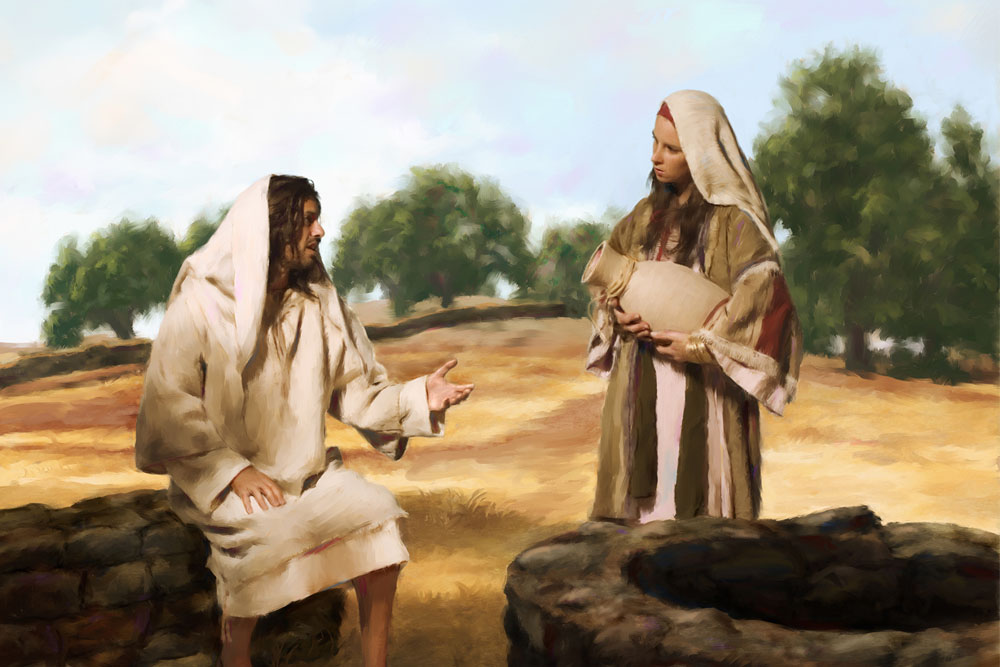
Soon the thirsty and hungry travelers arrived in Sychar. His disciples set off to find food in the nearby village while Jesus stayed to rest near Jacob’s well. He was not alone for long.
A Samaritan woman approached with her bucket to draw water. Women didn’t typically come to wells at midday. Water was drawn in the early morning and in the evening. From later details, she obviously came at that time to avoid others.
In keeping with social norms, she didn’t speak to the Jewish man sitting near the well. Jews were forbidden to speak to Samaritans, and it was inappropriate for women to address men in public. As she prepared to lower her bucket, Jesus interrupted her with an unlikely request, “May I have a drink of water?”
Startled, she paused, “Sir, how is it that you, a Jew, have asked me, a Samaritan woman, for a drink?” No Jew had ever spoken to her, let alone asked for a favor!
Instead of answering her question, Jesus replied, “If you knew the gift of God and Who it is that asks you for a drink, you would have asked Him to give you living water.”
“Sir,” the woman said, her intrigue growing, “you have nothing to draw with and the well is deep. Where can you get this living water? Are you greater than our father Jacob, who gave us the well and drank from it himself?” Her national pride was stirred. How could this Jewish stranger’s water be superior to what Jacob’s well supplied?
Jesus patiently answered, “Everyone who drinks this water will be thirsty again, but whoever drinks the water I give them will never thirst. Indeed, the water I give them will become a spring welling up in them to eternal life!”
Her curiosity turned to desire: “Sir, give me this water so that I won’t get thirsty and have to keep coming to this well!”
Noting her desire, Jesus instructed, “Go, call your husband and come back.”
“I have no husband,” she replied, hoping to keep her personal life out of the discussion.
With divine insight Jesus said: “You’re right when you say you have no husband. The fact is, you’ve had five husbands, and the man you’re living with is not your husband.”
Alarmed that the embarrassing details of her life were exposed, she quickly steered the conversation to a religious argument: “Sir, I can see that you are a prophet. Our ancestors worshiped on this mountain, but you Jews claim that we must worship in Jerusalem.”
“Woman,” Jesus respectfully replied, “believe me, a time is coming when you will worship the Father neither on this mountain nor in Jerusalem. You Samaritans worship what you do not know; we worship what we do know, for salvation is from the Jews. Yet a time is coming and has now come when the true worshipers will worship the Father in the Spirit and in truth, for they’re the kind of worshipers the Father seeks.”
At the end of Jesus' two-day visit in Samaria, the village elders declared, “This is indeed the Christ, the Savior of the world!”
The longing of her heart could no longer be hidden: “I know that Messiah is coming. When He comes, He will explain everything to us.” Disputed religious topics and even her failed relationships were forgotten. She was in pursuit of truth.
Then Jesus spoke directly, “I am He.”
It was an extraordinary revelation! One He hadn’t shared openly with His own people! He had taught and healed in Jerusalem and Judea, but the Jewish leaders’ prejudice had prevented Him from revealing who He truly was. Yet Jesus revealed to a woman from a despised culture, with a questionable reputation among her own people, that He was the world’s Messiah!
Not many nights before, the Jewish ruler Nicodemus had secretly sought Jesus for answers to his growing conviction that Jesus was no ordinary man. (See John 3.) But unlike His revelation to this thirsty woman, Jesus did not reveal Himself to Nicodemus as the Messiah. Nicodemus was schooled in skepticism and would need much more evidence than she would before accepting Him as the Messiah.
As the disciples returned with food, their faces registered their confusion to see Jesus talking with a Samaritan woman! Jesus no longer looked weary or hungry and the woman was ecstatic! But again, they kept their thoughts to themselves as they watched the woman forget her bucket and hurry back towards the village.
She arrived out of breath and beckoned eagerly to the men clustered at the city gate,“Come, see a Man who told me all things that I ever did! Could this be the Messiah?”
Curious, they followed her back to the well. On her testimony alone, they urged the Jewish teacher to come speak to their people.Jesus spent two days with the Samaritans, explaining the OT prophecies about Messiah.
These despised Samaritans confessed that Jesus was Messiah long before many Jews: “We ourselves have heard Him and we know that this is indeed the Christ, the Savior of the world.” John 4:42, NKJV.
Just before His ascension, Jesus told his disciples they would be His witnesses “in…Samaria, and to the end of the earth.” Acts 1:8. Nearly five years would pass from Jesus’ visit at the well until they returned to preach a crucified and risen Savior in Samaria. See Acts 8.
The disciples reaped a rich harvest of souls there. Yet they knew it was because Jesus had given living water to a despised Samaritan woman who couldn’t keep the good news of salvation to herself!
Image credit: © Sermonview.com

Betsy Mayer is the managing editor of Last Generation magazine.