Adam and Eve, at their creation, had a knowledge of the Law of God; they were acquainted with its claims upon them; its precepts were written upon their hearts.
When man fell by transgression, the Law was not changed, but a remedial system was established to bring him back to obedience. The promise of a Savior was given, and sacrificial offerings pointing forward to the death of Christ as the great sin offering were established.
But had the Law of God never been transgressed, there would have been no death and no need of a Savior; consequently, there would have been no need of sacrifices.
Adam taught his descendants the Law of God, and it was handed down from father to son through successive generations. But notwithstanding the gracious provision for man’s redemption, there were few who accepted it and rendered obedience.
As men again departed from God, the Lord chose Abraham of whom He declared, “Abraham obeyed My voice, and kept My charge, My commandments, My statutes, and My laws.” Gen. 26:5.
If the descendants of Abraham had kept the covenant, of which circumcision was a sign, they would never have been seduced into idolatry, and there would have been no necessity for it to be proclaimed from Sinai or engraved upon the tables of stone, and had the people practiced the principles of the Ten Commandments, there would have been no need of the additional directions given to Moses.
After the completion of the tabernacle, God communicated with Moses from the cloud of glory above the mercy seat and gave him full directions concerning the system of offerings and the forms of worship to be maintained in the sanctuary. The ceremonial law was thus given to Moses and by him written in a book. But the Law of Ten Commandments spoken from Sinai had been written by God Himself on the tables of stone and was sacredly preserved in the ark.
There are many who try to blend these two systems, using the texts that speak of the ceremonial law to prove that the moral Law has been abolished; but this is a perversion of the Scriptures. The distinction between the two systems is broad and clear.
The ceremonial system was made up of symbols pointing to Christ, to His sacrifice and His priesthood. This ritual law, with its sacrifices and ordinances, was to be performed by the Hebrews until type met antitype in the death of Christ, the Lamb of God that taketh away the sin of the world. Then all the sacrificial offerings were to cease. It is this law that Christ “took…out of the way, nailing it to His cross.” Col. 2:14.
But concerning the law of Ten Commandments, the Psalmist declares, “Forever, O Lord, Thy word is settled in Heaven.” Psalm 119:89. And Christ Himself says, “Think not that I am come to destroy the law.… Verily I say unto you” —making the assertion as emphatic as possible—“Till Heaven and Earth pass, one jot or one tittle shall in no wise pass from the law, till all be fulfilled.” Matt. 5:17, 18. The Law of God is as immutable as His throne. It will maintain its claims upon mankind in all ages.
While the Savior’s death brought to an end the law of types and shadows, it did not in the least detract from the obligation of the moral Law. On the contrary, the very fact that it was necessary for Christ to die in order to atone for the transgression of that Law proves it to be immutable.
As the Bible presents two laws, one changeless and eternal, the other provisional and temporary, so there are two covenants. The covenant of grace was first made with man in Eden, when after the Fall there was given a divine promise that the seed of the woman should bruise the serpent’s head. To all men this covenant offered pardon and the assisting grace of God for future obedience through faith in Christ. It also promised them eternal life on condition of fidelity to God’s Law. Thus the patriarchs received the hope of salvation.
This same covenant was renewed to Abraham in the promise, “In thy seed shall all the nations of the earth be blessed.” Gen. 22:18. This promise pointed to Christ. So Abraham understood it (see Gal. 3:8, 16), and he trusted in Christ for the forgiveness of sins. It was this faith that was accounted unto him for righteousness.
The covenant with Abraham also maintained the authority of God’s Law. The Lord appeared unto Abraham and said, “I am the Almighty God; walk before Me and be thou perfect.” Gen. 17:1.
The testimony of God concerning His faithful servant was, “Abraham obeyed My voice, and kept My charge, My commandments, My statutes, and My laws.” Gen. 26:5.
And the Lord declared to him, “I will establish My covenant between Me and thee and thy seed after thee in their generations for an everlasting covenant, to be a God unto thee and to thy seed after thee.” Gen. 17:7.
Though this covenant was made with Adam and renewed to Abraham, it could not be ratified until the death of Christ. It had existed by the promise of God since the first intimation of redemption had been given; it had been accepted by faith; yet when ratified by Christ, it is called a new covenant. The Law of God was the basis of this covenant, which was simply an arrangement for bringing men again into harmony with divine will, placing them where they could obey God’s Law.
The same law that was engraved upon tables of stone is written by the Holy Spirit upon the tables of the heart.
Another compact—called in Scripture the “old” covenant—was formed between God and Israel at Sinai and was then ratified by the blood of a sacrifice. The Abrahamic covenant was ratified by the blood of Christ, and it is called the “second,” or “new,” covenant, because the blood by which it was sealed was shed after the blood of the first covenant. That the new covenant was valid in the days of Abraham is evident from the fact that it was then confirmed both by the promise and by the oath of God—the “two immutable things, in which it was impossible for God to lie.” Heb. 6:18.
But if the Abrahamic covenant contained the promise of redemption, why was another covenant formed at Sinai? In their bondage the people had to a great extent lost the knowledge of God and of the principles of the Abrahamic covenant. In delivering them from Egypt, God sought to reveal to them His power and His mercy, that they might be led to love and trust Him. He brought them down to the Red Sea—where, pursued by the Egyptians, escape seemed impossible—that they might realize their utter helplessness, their need for divine aid; and then He wrought deliverance for them. Thus, they were filled with love and gratitude to God and with confidence in His power to help them. He had bound them to Himself as their deliverer from temporal bondage.
God brought them to Sinai; He manifested His glory; He gave them His Law with the promise of great blessings on condition of obedience: “If ye will obey My voice indeed, and keep My covenant, then…ye shall be unto Me a kingdom of priests, and an holy nation.” Ex. 19:5, 6. The people did not realize the sinfulness of their own hearts and that without Christ it was impossible for them to keep God’s Law; and they readily entered into covenant with God. Feeling that they were able to establish their own righteousness, they declared, “All that the Lord hath said will we do, and be obedient.” Ex. 24:7. They had witnessed the proclamation of the Law in awful majesty and had trembled with terror before the mount; and yet only a few weeks passed before they broke their covenant with God and bowed down to worship a graven image.
They could not hope for the favor of God through a covenant which they had broken; and now, seeing their sinfulness and their need of pardon, they were brought to feel their need of the Savior revealed in the Abrahamic covenant and shadowed forth in the sacrificial offerings. Now, by faith and love they were bound to God as their deliverer from the bondage of sin. Now, they were prepared to appreciate the blessings of the new covenant.
The new covenant was made with Adam and renewed to Abraham but could not be ratified until the death of Christ.
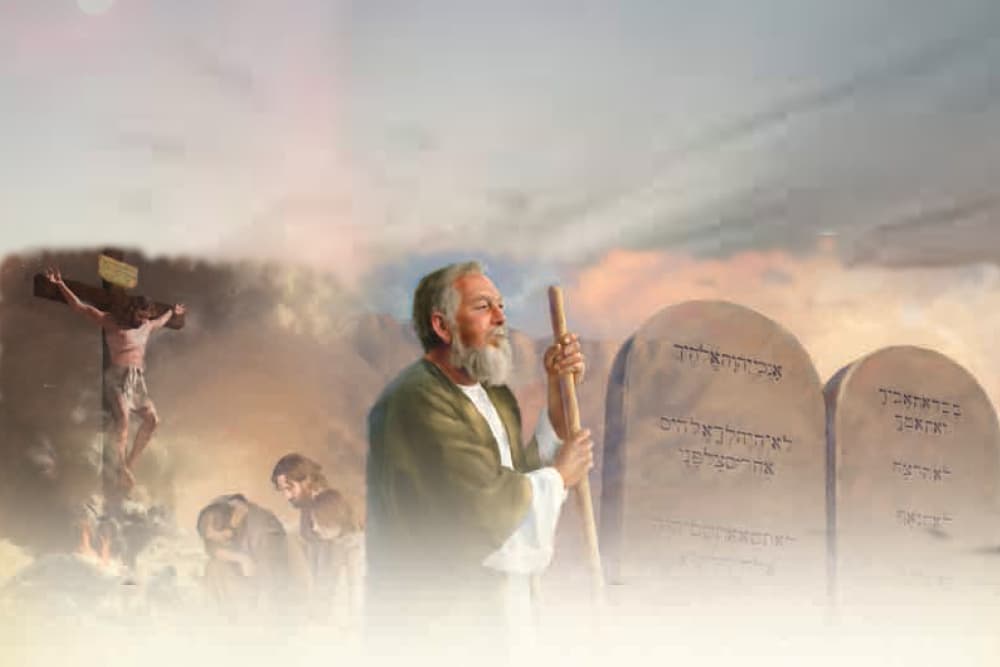
The terms of the “old covenant” were obey and live: “If a man do, he shall even live in them.” Ezek. 20:11. But “cursed be he that confirmeth not all the words of this law to do them.” Deut. 27:26. The “new covenant” was established upon “better promises”—the promise of forgiveness of sins and of the grace of God to renew the heart and bring it into harmony with the principles of God’s Law. “This shall be the covenant that I will make with the house of Israel; After those days, saith the Lord, I will put My law in their inward parts and write it in their hearts…. I will forgive their iniquity and I will remember their sin no more.” Jer. 31:33, 34.
The same Law that was engraved upon tables of stone is written by the Holy Spirit upon the tables of the heart. Instead of going about to establish our own righteousness, we accept the righteousness of Christ. His blood atones for our sins. His obedience is accepted for us. Then the heart renewed by the Holy Spirit will bring forth “the fruits of the Spirit.”
Through the grace of Christ we shall live in obedience to the Law of God written upon our hearts. Having the Spirit of Christ, we shall walk even as He walked. Through the prophet He declared of Himself, “I delight to do Thy will, O My God: yea, Thy law is within my heart.” Psalm 40:8. And when among men He said, “The Father hath not left me alone; for I do always those things that please Him.” John 8:29.
The apostle Paul clearly presents the relation between faith and the Law under the new covenant. He says: “Being justified by faith, we have peace with God through our Lord Jesus Christ.” “Do we then make void the law through faith? God forbid: yea, we establish the law.” “For what the law could not do, in that it was weak through the flesh”—it could not justify man, because in his sinful nature he could not keep the Law—“God sending His own Son in the likeness of sinful flesh, and for sin, condemned sin in the flesh: that the righteousness of the law might be fulfilled in us, who walk not after the flesh, but after the Spirit.” Rom. 5:1; 3:31; 8:3, 4.
Excerpted from Patriarchs and Prophets, “The Law and the Covenants,” by Ellen G. White.