
Recently, a radio host asked clergy from a variety of faiths to list the Ten Commandments. The majority could only list seven of them. Some did far worse. Only the Jewish Rabbi got them all, and in order!
As this radio program revealed, the Ten Commandments have fallen on hard times. And if religious leaders who claim to represent God have such a poor grasp of His commandments, is it any wonder that the societies in which they minister are fast falling into lawlessness and perversion?
And why should we be surprised by this? Shamefully, all that many have heard about the Law of God from Christian pulpits is that it was nailed to the cross and Christians are no longer obligated to keep it!
This was not the case among great Christian leaders and their followers down through the centuries. “The Law has sustained no diminution of its authority, but ought always to receive from us the same veneration and obedience,” wrote Calvin. (See also “Great Christians Speak on the Law of God” in this issue.) While the Ten Commandments were despised by skeptics, few Christians, even as late as the middle of the nineteenth century, denied the importance of keeping God’s Law.
What, then, has happened to God’s Ten Commandments? Who has dimmed their relevance in the lives of modern Christians? How has this change affected society at large?
Sadly, and surprisingly, the diminishing of the Ten Commandments has little to do with atheists, agnostics, non-Christians, or skeptics. This shift may be placed at the very feet of professed Christians themselves. Perhaps the shift happened as a reaction to the heavy emphasis upon the Law by “hell-fire preachers” which seemed to breed legalism and paint God as a harsh tyrant instead of a loving father. However, rather than recognizing the Law and love as indivisible Siamese twins, large numbers, including theologians and church pastors, landed in the other ditch of “love alone” salvation. Very quickly, Scripture was found that supposedly supported this false theology. Amazingly, the passage often used was Colossians 2:14–16:
“Blotting out the handwriting of ordinances that was against us, which was contrary to us, and took it out of the way, nailing it to his cross; and having spoiled principalities and powers, He made a shew of them openly, triumphing over them in it. Let no man therefore judge you in meat or in drink or in respect of an holyday or of the new moon or of the Sabbath days: which are a shadow of things to come, but the body is of Christ.”
On closer study, it is obvious this passage is not referring to the moral law as expressed in the Ten Commandments. Plainly, it deals with the statutes, ordinances, and sacrifices of the Hebrew ceremonial law and sanctuary service. If there were any doubt, the apostle’s own words make it clear. The law which was nailed to the cross was the law “that was against us.” We are plainly told by Moses which law this was: “Take this book of the law and put it in the side of the ark of the covenant of the Lord your God, that it may be there for a witness against thee.” Deut. 31:26.
Which book of the law was this? Because of where it was placed, we know it was not the Ten Commandments written by God’s finger and placed inside the ark. It was the ceremonial law written by man and placed on the outside of the ark. But, armed with a false interpretation of this text, it was confidently stated that after the cross we were under grace and were no longer obligated to keep the Ten Commandments. This led to the error of dispensationalism, the view that those who lived after the death of Christ were saved in an entirely different way from those who lived during the pre-Christian era. This false doctrine was spread far and wide in the nineteenth century by John Darby, who founded the Plymouth Brethren Church and greatly influenced the American mainline churches. Dispensationalism was further spread by Cyrus Scofield, who developed and promoted the Scofield Reference Bible.
In reality, not one soul will ever be saved without the grace of Christ. Just as Christians today are saved by grace through faith, so those before the death of Christ were also saved by grace through faith. This is plainly stated in Hebrews, chapter eleven.
Neither will anyone be saved by keeping the Ten Commandments, “For there is none other name under Heaven given among men, whereby we must be saved.” Acts 4:12. Yet, those who have surrendered their wills to Christ will be keepers of the Ten Commandments in His strength and power, for this is how they are described in Scripture: “Here is the patience of the saints: here are they that keep the commandments of God, and the faith of Jesus.” Rev. 14:12. Furthermore, only commandment keepers will be admitted to Heaven: “Blessed are they that do His commandments, that they may have right to the tree of life and may enter in through the gates into the city.” Rev. 22:14.
This anti-Law attitude was further fueled by the Danish theologian-philosopher Sören Kierkegaard (1813–1855), the founder of modern existentialism. In its simplest form, existentialism proposes that what is “ethical” or “moral” is entirely subject to the individual’s reasoning. At first this concept gathered few disciples, but in the 20th century it was strongly promoted in the theology of Karl Barth. His beliefs about “moral absolutes” became known as situational ethics, the concept that there are no absolute principles of right and wrong; rather, everything is determined by the situation. Many, including a number of Christians and teachers of theology, took hold of this unbiblical concept, teaching that the “loving thing to do” might include actions such as mercy killing, abortion, divorce, and the telling of “white” lies. Those who promote this concept of “love” must have forgotten that the carnal heart naturally seeks to rationalize behavior that suits its desires.
In the end, both “liberal” and “conservative” churches have contributed to the imbalance in today’s Christian theology and to the almost total exclusion of the law in gospel presentations. In the 20th century, this has caused some serious errors to develop in the thinking of people living in “Christian” nations:
Antinomianism: the belief that the Law is no longer binding upon the lives of Christians.
Dispensationalism: the view that humans have been saved in different ways throughout history.
Existentialism: the philosophy that man himself decides what is right and wrong.
Situational ethics: the idea that the situation or circumstances determine whether behavior is right or wrong.
Post-modernism: the disbelief in the concept of absolutes and a divine Law, and the belief that law is purely the invention of a powerful few to dominate the powerless masses.
The impact of these ideas has been dramatic. Promoted by preachers and professors, they have spread to the home and have pervaded society at large. Is it any wonder there is such a state of lawlessness today?
When those who professed to be God’s people were unfaithful and disobedient to Him, God accused them of spiritual adultery. The prophets of God called them harlots: “There were two women… Aholah, the elder, and Aholibah, her sister.… Samaria is Aholah, and Jerusalem Aholibah…. And with their idols have they committed adultery.” Ezek. 23:2, 4, 3, 7.
In Revelation 17:5, John is shown an impure church whose name is “BABYLON THE GREAT, THE MOTHER OF HARLOTS AND ABOMINATIONS OF THE EARTH.” In Revelation 14:8, an angel describes Babylon as fallen. If fallen, then somewhere in her past she was pure and united in love and loyalty to God and His Commandments.
What caused her to fall from her honored position as the bride of Christ? “Because she made all nations drink of the wine of the wrath of her fornication.” Rev. 14:8.
Babylon, the once-pure church, is condemned by God because she has caused millions to lose their spiritual discernment. When the Church elevated and taught the whole Word of God, her children and the nations they composed had spiritual discernment. But when the Church strayed from the pure light of God’s Word and began to teach error, then she spread her unfaithfulness—the wine of her fornication—to her followers and eventually their societies. Any church that teaches her followers to disregard God’s Law, or even one precept of that Law, belongs to the sisterhood of churches the Bible calls Babylon.
In His famous Sermon on the Mount, Jesus taught that Heaven and Earth would cease existing before even a “jot or... tittle” could pass from the Law. Then He warned:
“Whosoever therefore shall break one of these least commandments, and shall teach men so, he shall be called the least in the kingdom of heaven: but whosoever shall do and teach them, the same shall be called great in the kingdom of heaven.” Matt. 5:19.
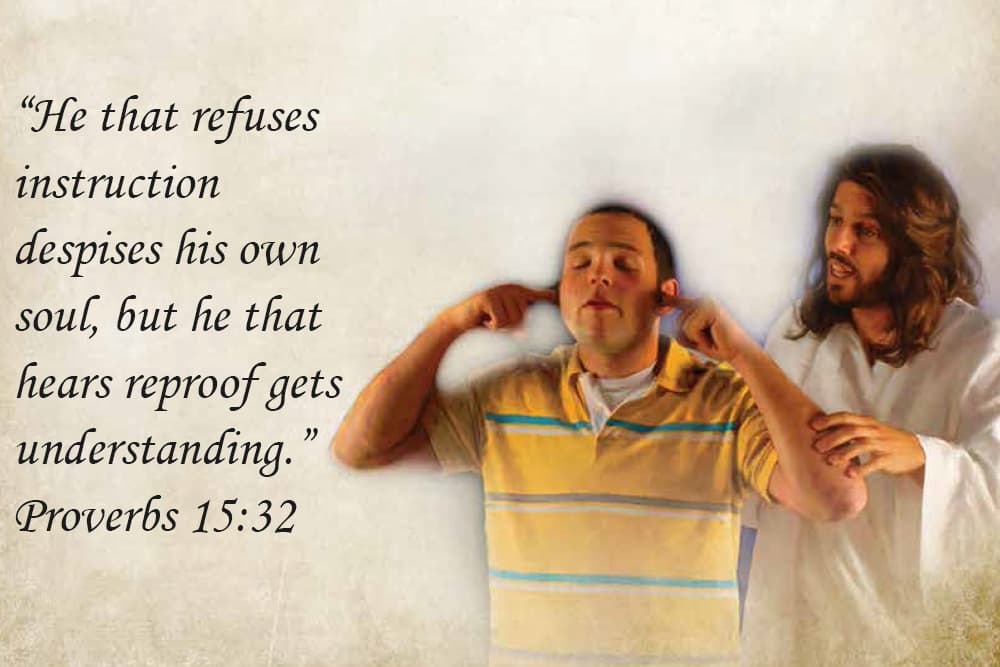
But does any church really teach that it’s okay to steal and lie, to murder your neighbor, or to sleep with his wife? No, not really, though some churches may have a lower view of murder, for instance, than other churches. The issue of abortion is one such case.
A quick review of the Ten Commandments reveals only one commandment that causes most Christians to squirm—the commandment to honor God’s seventh-day Sabbath. The vast majority of Christians ignorantly honor Sunday, a day chosen by the Roman Emperor Constantine in the fourth century to unite the Christians and pagans of his realm. The marriage of these diverse groups yielded a state-sponsored church termed catholic, or universal, as opposed to those that would not unite under Constantine’s decrees whose churches were termed “heretical” and “schismatic.” These latter groups were eventually banned, persecuted, and exiled or, if persistent, were annihilated.
For many centuries, Christians who sought to honor all of God’s Ten Commandments met in secret or fled to regions of the earth where the Roman Empire was not in control. John depicts this persecuted and scattered church as the church in the wilderness. See Rev. 12.
The Bible predicts that, just prior to the last conflict between good and evil, Satan will once again persecute a remnant of God’s commandment-keeping people:
“And the dragon was wroth with the woman and went to make war with the remnant of her seed, which keep the commandments of God and have the testimony of Jesus Christ.” Rev. 12:17.
Revelation 13 reveals how Satan will use the Beast, Babylon’s leader, to persecute this commandment-keeping remnant right at the end of time. Because Babylon is hardening herself in rebellion against God and will once more persecute His saints, God is calling all His people out of her fellowships before He sends His last plagues on her and her children. Rev. 18:1–5. We believe that these prophecies are soon to be fulfilled.
Today, it is important for you to choose to be among God’s commandment-keeping people. Soon, the world will be divided into only two groups: those who are loyal to the Beast power and those who are loyal to God. As the world chooses another master, you may show your love and loyalty to Jesus by honoring all His Ten Commandments, for He has said: “If ye love Me, keep My commandments.” John 14:15.

The late Dr. Colin Standish was a pastor and an educator, serving as president of several Christian colleges. Betsy Mayer is the managing editor of Last Generation.